AI has transformed competitor research, making it faster, smarter, and more actionable, particularly through AI keynotes that explore these business shifts. Instead of spending weeks manually gathering data, you can now use AI tools like ChatGPT to analyze competitors’ pricing, messaging, product launches, and customer reviews in minutes. Here’s how AI can help:
- Identify competitors quickly: AI scans websites, social media, and reviews to find direct, indirect, and emerging competitors.
- Organize competitor data: Group competitors into categories (direct, indirect, emerging) and analyze their strengths, weaknesses, and market positioning.
- Analyze strategies: AI evaluates competitors’ marketing messages, product features, and pricing to spot gaps and opportunities.
- Track trends in real time: Get instant alerts on competitor updates like price changes, new features, or shifts in messaging.
- Improve SEO and content: Analyze competitor content, keywords, and publishing patterns to refine your own strategy.
AI tools streamline complex tasks, helping you make data-driven decisions and stay ahead of the competition. Whether you’re identifying market gaps, refining your messaging, or improving your SEO, AI makes the process efficient and effective. Start small, like analyzing competitor content, and scale your efforts as you see results.
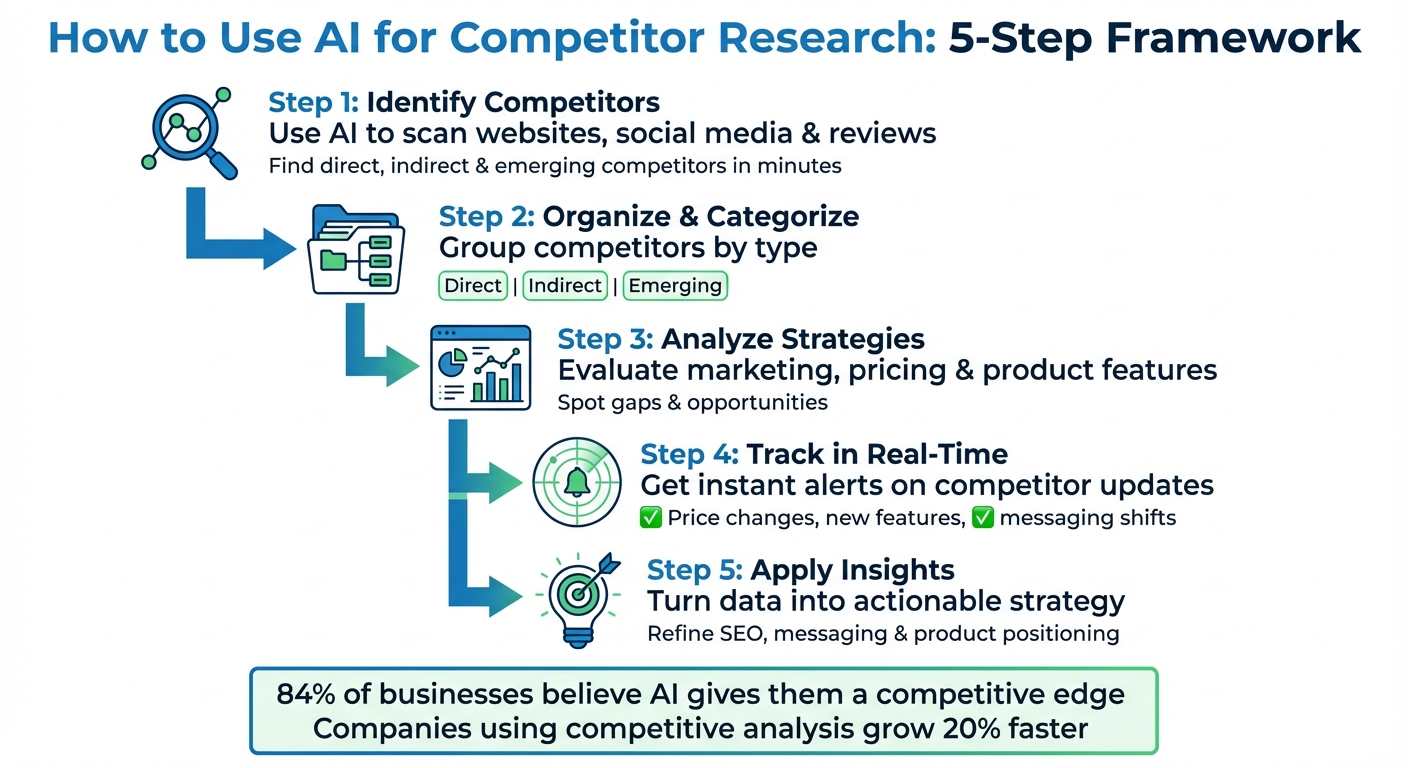
AI-Powered Competitor Research Workflow: 5 Key Steps
How to use AI to do quick competitive analysis
sbb-itb-7878072
Identifying Competitors Using AI
Pinpointing all competitors, including indirect and up-and-coming players, has always been a tricky task. But now, AI tools like ChatGPT can simplify this process dramatically. By analyzing patterns across websites, social media platforms, and customer reviews, these tools can reveal hidden competitors in just minutes [2]. This shift from manual research to AI-driven analysis makes competitor identification faster and more efficient.
Creating Competitor Lists with AI
When using tools like ChatGPT for business to generate a competitor list, it’s important to provide detailed market parameters rather than vague queries. For instance, try asking:
"Identify emerging competitors in the project management software market and assess their unique selling points, target audience, and growth strategies." [1]
This kind of specific request not only gives you a list of competitors but also helps uncover what makes each one relevant in the market.
For a more detailed analysis, append /sitemap.xml to a competitor’s website URL and upload the file to ChatGPT with Advanced Data Analysis. This allows you to extract and categorize URLs by content themes [7]. This method is particularly useful for identifying content competitors – those vying for the same keywords you’re targeting.
Another approach involves mining customer reviews. Extract reviews from platforms like the Google Play Store or Amazon and prompt ChatGPT to identify alternative brands mentioned by customers [6]. This sentiment-driven approach highlights the brands that consumers actively consider when making purchasing decisions.
Grouping Competitors by Type
Once you’ve compiled a thorough competitor list, AI can help you organize them into distinct categories:
- Direct Competitors: Businesses offering the same product to the same audience.
- Indirect Competitors: Companies providing different products that address the same problem.
- Emerging Competitors: New players entering the market and showing signs of growth.
You can feed ChatGPT information about pricing, features, and target audiences to automatically classify competitors into these groups [2].
AI also tracks signals like job postings, patent filings, and partnership announcements to identify emerging competitors that are scaling up [1][2]. For a visual approach, use strategic group mapping to plot competitors based on dimensions like pricing versus feature set. This can help you identify "white space" in the market – those underserved segments where customer needs are not being fully addressed [2]. Proper categorization like this sets the stage for deeper strategy analysis and actionable insights.
Analyzing Competitor Strategies and Offerings
Once you’ve categorized your competitors, the next step is to dive into their operations and figure out what drives their success. With AI, this process becomes faster and more efficient – it can analyze vast amounts of data in minutes, uncovering patterns and delivering insights that might otherwise take weeks to identify.
Marketing and Messaging Analysis
Understanding how your competitors communicate their value is key to positioning your brand effectively. Tools like ChatGPT can analyze competitor branding and messaging by processing content from their websites, social media, and advertising. Since AI relies on the data you provide, you can input text from competitor landing pages, ads, or social media posts to get an accurate analysis.
For example, try this prompt: "Analyze the following competitor ad copy and website text. What are their primary value propositions, target audience, and brand tone?" [1]. This approach not only reveals what your competitors are saying but also how they’re saying it. Are they focusing on price? Highlighting quality? Promoting innovation or customer service? Automated alerts can even notify you of shifts in competitor messaging, price changes, or new campaigns, giving you real-time updates to refine your strategy.
Product and Service Comparison
Side-by-side comparisons are a great way to identify market gaps and pricing opportunities. AI can quickly analyze product descriptions, feature lists, and pricing from multiple competitors, organizing the data into an easy-to-read format. Here’s an example framework:
| Competitor | Key Features | Pricing (USD) | Target Audience | Unique Selling Point |
|---|---|---|---|---|
| Competitor A | Feature set 1, Feature set 2 | $49/month | Small businesses | 24/7 customer support |
| Competitor B | Feature set 1, Feature set 3 | $79/month | Enterprise clients | Advanced analytics |
| Your Business | Feature set 2, Feature set 4 | $59/month | Mid-market companies | AI-powered automation |
Using ChatGPT, you can refine this further with a prompt like: "Compare [Your Product] to [Competitor], focusing on strengths, gaps for improvement, and alignment with customer needs" [1]. This process helps you see if your pricing is competitive, if your features align with market demand, or if there are areas where you stand out – or fall short. For real-time price monitoring, tools like Prisync can alert you to competitor price changes, allowing you to respond quickly [4]. These detailed comparisons can help you pinpoint opportunities to strengthen your position in the market.
Finding Strengths and Weaknesses
AI tools like ChatGPT can also help you identify competitor strengths and weaknesses through sentiment analysis. By categorizing customer feedback into clear pros and cons, you can uncover valuable insights. For instance, if reviews frequently mention that a competitor’s software is "powerful but too complicated", you could highlight ease of use as a key benefit in your own messaging.
"I don’t think it [ChatGPT] did anything magic that I couldn’t have done myself but the efficiency I gained from doing it this way was huge."
- Laura Jones, entrepreneur and marketer, who like AI expert Lasse Rouhiainen emphasizes the efficiency gains of these tools [6]
Customizable alerts can also notify you of important events – like new landing page launches or changes in ad spending – so you can adjust your strategy dynamically. Armed with these insights, you’ll be better equipped to refine your offerings and address market gaps effectively.
Using AI for Content and Keyword Analysis
AI has revolutionized the way we approach content and SEO research, turning what used to be time-consuming tasks into quick, actionable insights. By analyzing competitor content and identifying the keywords driving their traffic, you can refine your own strategy or even develop a business plan with ChatGPT. AI tools can scan hundreds of competitor pages in just minutes, uncovering patterns that go far beyond simple keyword lists. They help you understand themes, publishing frequency, and the search intent behind competitor content.
Reviewing Content Themes and Publishing Patterns
One of AI’s strengths lies in its ability to categorize competitor content into distinct themes. By doing so, it helps you identify what’s resonating in your market. For example, you can input a list of competitor blog titles or URLs into tools like ChatGPT, and it will group them into categories such as educational guides, product comparisons, or customer success stories. This analysis reveals whether competitors are focusing on informational FAQs, transactional product pages, or other types of content – and how often they publish [1][8].
AI can also pinpoint content gaps. Simply paste competitor URLs into ChatGPT and ask it to analyze what’s missing. For instance, you might request: "Analyze these three competitor articles and identify topics, data points, or questions they didn’t cover" [11]. This approach helps you uncover opportunities to add value. In one case, addressing content gaps identified by an AI assistant led to a significant boost in organic traffic [10].
Another emerging trend is tracking which competitor pages are being referenced by AI chatbots like ChatGPT and Perplexity. In July 2024, Similarweb used their AI Chatbot Traffic tool to analyze the domain SensorTower and discovered that 100% of chatbot-referred traffic went to specific competitor reports and blog pages. By identifying the user prompts that directed traffic to SensorTower’s "App Intelligence" page, they developed new high-performing content ideas for their own strategy [9]. This practice, known as Generative Engine Optimization (GEO), helps businesses understand which content themes AI systems trust and recommend.
Once you’ve gathered insights into content themes and publishing patterns, the next step is to dive into keyword analysis with AI.
Keyword and SEO Analysis
After identifying content themes, the focus shifts to the keywords driving competitor visibility. AI tools shine here, making "keyword gap analysis" faster and more precise. Instead of manually combing through search results, AI can automatically identify keywords your competitors rank for but you don’t. Tools like Search Atlas, SEMrush, and Ahrefs can analyze thousands of keywords, highlighting those with high search volume and low competition – ideal for quick wins [10][12].
For example, between 2024 and 2025, Dr. David McInnis Orthodontics used Search Atlas’s AI-powered SEO tools to restructure their website around high-intent keywords identified through competitor gap analysis. Over six months, they targeted more than 250 keywords, achieving a 472% increase in organic traffic and a 380% growth in patient inquiries [10]. Their success came from focusing on keywords their competitors had already capitalized on but were missing from their own strategy.
AI also helps identify keywords that trigger Google’s AI-generated summaries, giving you a clearer picture of high-authority content [9]. You can even use ChatGPT to evaluate whether a competitor’s page aligns with their intended SEO strategy [11]. As Maayan Zohar Basteker, Senior SEO Specialist at Similarweb, puts it:
"The goal isn’t just to rank. It’s to position your brand as a trusted source of information that AI systems choose to summarize and cite" [9].
Additionally, AI can uncover opportunities for authoritative backlinks, strengthening your overall SEO strategy [12]. By combining content theme analysis with keyword intelligence, AI transforms competitor research from guesswork into a precise, data-driven process.
Applying AI Insights to Your Business Strategy
Turning Insights into Actions
Gathering AI data is just the starting point – the real impact comes from turning those insights into actionable business strategies. Companies that regularly perform competitive analysis see growth rates up to 20% faster [13].
To make the most of your data, begin by identifying 3–5 key strategic questions. For instance, you might ask, “What pricing gaps exist in our market?” or “Which product features receive the most complaints in competitor reviews?” This targeted approach helps your team focus on what truly matters and avoids unnecessary data overload. After collecting insights, use tools like SWOT analysis or Strategic Group Mapping to uncover market "white spaces" – those untapped areas where your business can stand out [2].
Automate the process by setting up alerts to notify your team when competitors adjust pricing, introduce new features, or shift their messaging. These real-time updates create a dynamic intelligence system [1][2]. Additionally, integrating AI tools with your CRM and communication platforms ensures that insights are shared promptly and effectively [3].
AI insights can enhance multiple areas of your business. For example, sentiment analysis can guide product improvements, fine-tune marketing efforts, and help address keyword gaps for better SEO performance [3][14]. Shingly Lee, VP of Marketing at GURU Energy, emphasizes this approach:
"It all starts with our positioning and really understanding which consumers or groups and segments of consumers are most capable of loving what your brand does" [14].
Interestingly, 84% of businesses believe AI can give them a competitive edge – but that advantage only materializes if they act on the insights [13]. Start small by focusing on a single use case, such as analyzing competitor content. Quick wins like these can build momentum and gain stakeholder support, paving the way for broader AI-driven strategies [3]. These steps lay the groundwork for scaling your efforts and leveraging additional resources to strengthen your capabilities.
Resources from Artificial Intelligence Keynote Speaker
For deeper insights into building an AI-driven strategy, Lasse Rouhiainen’s book, "ChatGPT – 101 Things You Must Know Today About ChatGPT and Generative AI," is a valuable resource. It provides actionable strategies for applying tools like ChatGPT to business challenges, including workflows for competitor research. The book features specific prompts, case studies, and frameworks that you can implement right away.
Another option is the 90-day AI Consultant Accelerator program, which offers personalized mentoring and hands-on projects. This program equips you with the skills to create AI assistants and design outreach strategies, making it ideal for those looking to lead AI initiatives or provide consulting services. You can find these resources, along with free video lessons, at lasserouhiainen.com.
Conclusion
Key Takeaways
AI is transforming how businesses conduct competitor research. By analyzing hundreds of data points in just minutes, AI uncovers patterns that might otherwise go unnoticed [2]. This shift from static, periodic reports to real-time intelligence ensures businesses are armed with the most up-to-date insights [1][2].
Some of the standout benefits include automated data collection from various sources, real-time monitoring with instant alerts for competitor updates, and predictive capabilities that anticipate future moves like pricing changes or product launches. A McKinsey report highlights that 50% of organizations have already integrated AI into at least one area of their operations [5].
The real value lies in applying these insights effectively. Start by defining 3–5 clear strategic questions to guide your research. Use frameworks like SWOT analysis to structure your findings and set up automated alerts to track competitor activities [2]. Begin with a small, focused use case – such as analyzing competitor content – to demonstrate the potential of AI-driven insights, then expand your efforts from there [3]. These insights can directly inform actionable strategies for your business.
Next Steps
Ready to dive into AI-powered competitor research? Begin with tools like ChatGPT, which can help analyze competitor websites, reviews, and content strategies. Start small by addressing a specific challenge, such as identifying pricing gaps, uncovering content trends, or understanding customer sentiment.
For those looking to deepen their knowledge, check out resources at lasserouhiainen.com. The site offers free video lessons on practical AI applications and a 90-day AI Consultant Accelerator program with hands-on mentoring. These tools and insights can provide a real competitive advantage.
FAQs
How can AI help identify hidden and emerging competitors?
AI tools can help you spot competitors you might not have considered by diving into various data sources like annual reports, patent filings, job postings, and social media. With the power of natural language processing, these tools can highlight companies tackling similar customer needs or operating in related markets – even if they aren’t on your radar yet.
After gathering the data, AI steps in to identify patterns and trends. For example, it can detect increases in marketing efforts or hiring for new product launches. By grouping and ranking companies based on shared characteristics or keywords, you can uncover indirect competitors and keep tabs on up-and-coming players in your industry. To begin, start by clearly defining the problem your business solves, collect data from a variety of sources, and use AI tools to continuously monitor and refine your competitor list. For additional insights on creating AI-powered workflows, explore the resources at Artificial Intelligence Keynote Speaker.
How can AI improve SEO and content strategies?
AI can play a game-changing role in shaping your SEO and content strategies, especially with tools like large language models (LLMs) such as ChatGPT. These models excel at creating engaging blog posts, optimized meta descriptions, and targeted FAQs that hit the right keywords while addressing user intent. On top of that, they can analyze competitor content to pinpoint gaps, helping you focus on topics that can elevate your rankings.
Beyond content creation, AI-powered tools using natural language processing (NLP) can take your strategy further. They can extract and group keywords, assess sentiment in reviews or social media mentions, and reveal semantic connections. This kind of insight is invaluable for fine-tuning on-page optimization and planning your content roadmap.
AI also lends a hand with link-building by analyzing competitor backlink profiles to uncover high-authority opportunities. This ensures your strategy stays competitive, data-driven, and ready to adapt to the ever-changing SEO landscape.
How can AI help analyze competitors’ marketing strategies and product features?
AI has reshaped how businesses approach competitor analysis, making the process faster and more efficient. By processing vast amounts of data – like marketing materials, social media activity, and press releases – AI tools can uncover key themes, analyze tone and messaging strategies, and even summarize content. With features like sentiment analysis, these tools can also assess how audiences react to competitors’ campaigns, transforming what used to take hours of manual research into actionable insights in just minutes.
When it comes to product analysis, AI takes things a step further. It can evaluate screenshots, videos, and product specifications, allowing businesses to compare features across competitors with impressive speed. Machine learning algorithms can spot patterns like pricing trends or shifts in design and may even predict upcoming updates. Armed with this information, companies can adapt to market changes and fine-tune their strategies. For those seeking to dive deeper, the Artificial Intelligence Keynote Speaker site provides workshops and consulting services to help professionals maximize AI’s potential for competitive intelligence.