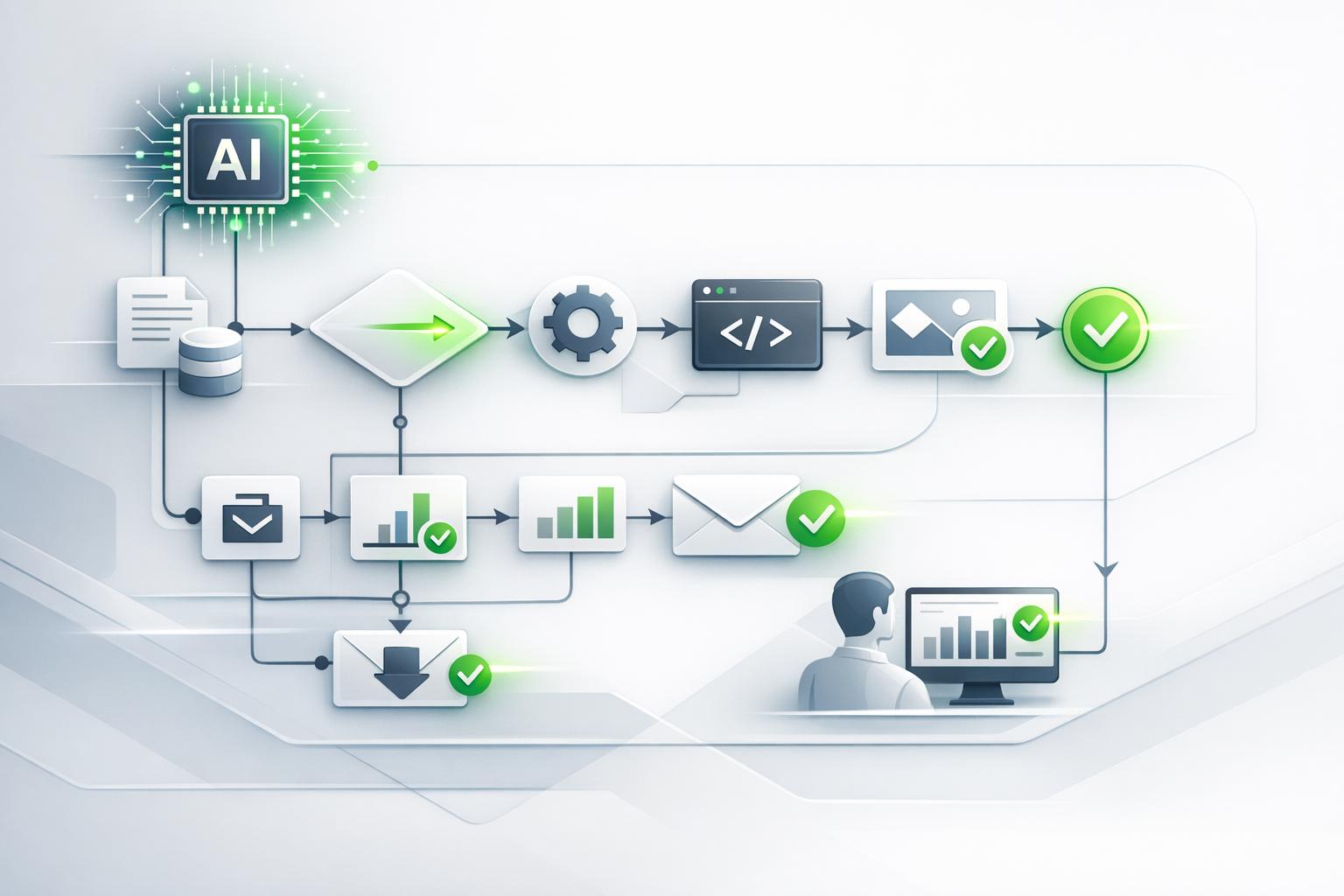
AI is transforming government operations by automating repetitive tasks, improving citizen services, and supporting data analysis. Here’s how it works:
- Automating Tasks: AI drafts emails, summarizes documents, and manages projects, saving time for government workers.
- Citizen Services: Chatbots provide 24/7 support, answering common questions and simplifying complex information.
- Data Analysis: AI detects patterns in public data, monitors program performance, and helps with decision-making.
While AI streamlines processes, human oversight is critical to ensure accuracy, fairness, and accountability. By integrating AI responsibly, governments can improve efficiency and better serve the public.
How AI is transforming government | GTAC webinar
AI Basics for Government Workflows
Before introducing AI into government operations, it’s essential to understand how these tools differ from existing systems. Many government agencies already use automation for tasks like processing forms or scheduling appointments. AI takes this a step further by handling more complex tasks that typically require human judgment. The following sections explore key differences, technical considerations, and oversight practices necessary for integrating AI into government workflows.
Generative AI vs. Standard Automation
Standard automation works by following strict, predefined rules. For instance, when someone submits a permit application online, an automated system can route it to the correct department, send a confirmation email, and update a database. These systems excel in scenarios where clear if-then logic applies.
Generative AI, on the other hand, operates on a completely different level. Tools like ChatGPT don’t just follow a script – they create new content, understand context, and adapt to diverse inputs. Instead of being programmed for every possible scenario, they analyze patterns in massive datasets to generate contextually relevant responses.
This distinction is important for government tasks. Generative AI can handle work that goes beyond the rigid capabilities of standard automation, such as drafting meeting agendas, creating initial versions of reports, or responding to unique public inquiries. These tools provide flexibility for tasks that are too varied for traditional automation systems.
However, because generative AI produces content independently, its outputs require careful review to ensure accuracy and appropriateness.
Technical and Policy Requirements
Understanding the types of AI is just the beginning. Agencies also need to address technical and policy-related challenges. Government operations often involve sensitive information – citizen records, financial data, personnel files, and even classified materials – which means AI systems must meet strict security standards. This might involve using government-specific AI instances, on-premises installations, or cloud services certified under the Federal Risk and Authorization Management Program (FedRAMP).
Legal compliance is another critical factor. AI tools must adhere to laws like the Privacy Act of 1974 and relevant state privacy regulations. Federal agencies are also guided by emerging AI governance policies. For example, the Office of Management and Budget has issued directives requiring agencies to inventory their AI use cases, assess risks, and establish oversight mechanisms.
From a technical standpoint, AI systems need robust user authentication, audit logging, and seamless integration with existing IT infrastructure. This often involves connecting AI tools to case management systems, document repositories, and communication platforms through APIs, enabling single sign-on, and ensuring IT teams are equipped to manage these integrations effectively.
Budget planning is equally important. While some AI tools may have low initial costs, agencies must account for ongoing expenses such as licensing fees, staff training, and technical support. Given that government procurement processes can take months, planning should start well in advance of deployment.
Human-in-the-Loop Workflow in Government
AI should never operate independently when making decisions that affect citizens or public resources. A human-in-the-loop approach ensures that while AI generates outputs, trained staff review, verify, and approve them before they are finalized.
This approach is critical because AI outputs can sometimes be inaccurate. In government work, where decisions directly impact lives and public funds, unchecked errors could have serious consequences. For instance, an incorrect benefits eligibility letter could deny someone essential support, or a flawed budget analysis might misallocate resources.
Human oversight helps correct errors, maintain accountability, and address potential biases in AI-generated content. When agencies communicate with the public or make policy decisions, a human must ultimately take responsibility. This accountability is essential for maintaining public trust.
The level of review required depends on the task. Routine activities, like drafting internal emails, may only need a quick check. However, high-stakes tasks – such as policy recommendations or public communications – should undergo thorough evaluation, often by multiple experts. Some agencies even implement approval hierarchies to ensure AI-assisted work meets the same standards as work completed without AI.
Staff training is key to making this process effective. Employees need to understand both the strengths and limitations of AI tools and apply clear criteria to evaluate outputs. Proper training prevents overreliance on AI while ensuring that valuable insights aren’t overlooked.
The ultimate goal is to improve efficiency without compromising quality or accountability. By implementing a structured human-in-the-loop process, government employees can leverage AI to enhance productivity while maintaining the high standards expected by the public.
Automating Administrative Tasks with AI
Government employees often find their days consumed by administrative tasks – drafting correspondence, summarizing lengthy documents, and managing projects. These tasks, while necessary, can detract from time spent on higher-level responsibilities that require human judgment and creativity. That’s where AI steps in. By taking over repetitive tasks, AI allows employees to dedicate more energy to strategic and impactful work.
The key is identifying which administrative tasks can be automated while ensuring human oversight remains in place. Done correctly, AI can handle routine paperwork efficiently without sacrificing the quality expected in government operations. Below, we explore how AI can assist with drafting, summarizing, and project management.
Drafting and Editing Written Materials
Writing is a major part of government work. Employees draft everything from emails and memos to detailed reports and policy briefs. Each document demands careful attention to tone, clarity, and accuracy, but the initial drafting process doesn’t always require starting from scratch.
AI tools, like ChatGPT, can generate first drafts based on brief instructions. For example, an employee can input a few bullet points outlining the key message, specify the target audience, and request a particular tone – whether formal, conversational, or technical. Within seconds, the AI produces a draft that the employee can refine, fact-check, and personalize.
For more complex documents, such as policy briefs or legislative summaries, AI can provide a logical structure. An employee might ask it to organize content into sections like background, current situation, options for action, and recommendations. This framework speeds up the writing process while leaving room for the employee to incorporate verified data and analysis.
AI also shines when it comes to editing and refining text. Government documents often need to be accessible to a wide audience, including those unfamiliar with technical jargon. Staff can use AI to simplify language, suggest alternatives, or adjust the reading level, making public-facing materials clearer for citizens with varying levels of education and English proficiency.
Another practical application is tone adjustment. For instance, a memo might sound too casual for a formal report or too rigid for a community newsletter. AI can rewrite sections to strike the right balance, saving employees from manually reworking entire drafts.
Despite these advantages, employees must always verify that AI-generated content aligns with agency policies and accurately represents the facts. AI lacks the nuanced understanding of government programs and policies unless explicitly provided with that information. Human oversight is essential to ensure the final product meets the required standards.
Summarizing and Converting Documents
AI also simplifies the tedious task of reviewing and reformatting lengthy documents. Government employees frequently deal with extensive materials, such as meeting transcripts, legislative texts, research reports, and public comments. Extracting key points from hundreds of pages is time-intensive but often necessary for informed decision-making.
AI excels at creating concise summaries. For example, an employee can upload a 50-page report and request a one-page executive summary that highlights the main findings, recommendations, and action items. While this doesn’t replace the need to read the full document for critical decisions, it helps staff quickly identify which materials need immediate attention.
Meeting minutes are another area where AI proves helpful. After a lengthy meeting, someone typically needs to compile notes into a coherent summary, capturing decisions, action items, and follow-ups. If the meeting was recorded and transcribed, AI can process the transcript and produce an organized summary. Staff can then review and refine the draft for accuracy and completeness.
AI is also valuable for legislative analysis. When new bills are introduced, government agencies often need to assess their potential impact. AI can summarize lengthy legislative texts into plain language, identifying the sections most relevant to the agency’s work. This allows analysts to focus their detailed review on the most critical areas.
In addition, AI can convert information between formats. For example, a dense technical report might need to be summarized into talking points for a public presentation, or a series of emails could be compiled into a status update for leadership. AI can restructure content for different formats while retaining the core information.
Handling public comments is another challenging task AI can simplify. When agencies solicit feedback on proposed rules or policies, they may receive thousands of submissions. AI can categorize these comments by theme, highlight common concerns, and flag unique perspectives for closer review. This allows staff to focus on substantive issues rather than sorting through repetitive entries.
Project and Task Management Support
Project management in government involves juggling multiple stakeholders, tracking deadlines, and ensuring compliance with regulations. While strategic decisions and oversight remain human responsibilities, AI can provide support with planning and organization.
For example, when launching a new initiative, staff can use AI to draft project plans. By inputting objectives, constraints (e.g., budget, timeline, staffing), and regulatory requirements, employees can ask AI to suggest a structured approach. The AI might outline phases, identify dependencies, and recommend progress checkpoints. Project managers can then refine these drafts to align with team priorities and capacity.
AI also helps create checklists and standard operating procedures for recurring tasks. Whether it’s processing permit applications, conducting inspections, or preparing for audits, many government processes follow established protocols. Instead of drafting checklists from scratch each time, staff can use AI to generate comprehensive lists based on best practices and regulatory requirements, then tailor them to agency-specific needs.
For task prioritization, AI can assist when employees are managing competing responsibilities. By listing tasks along with details like deadlines, importance, and dependencies, staff can ask AI to suggest a logical order for tackling them. This helps employees organize their workload more effectively.
Documentation is another area where AI adds value. Maintaining detailed records of decisions, changes, and progress is essential for accountability, but writing these records often gets postponed during busy periods. AI can draft progress reports from brief updates, create templates for recurring documentation, and organize notes into coherent records. This allows staff to keep thorough documentation without spending excessive time on it.
AI can also assist with resource planning by analyzing historical data from similar projects. For example, if an agency has completed comparable initiatives, AI can review past records to estimate task durations, anticipate challenges, and suggest resource needs. This helps managers create more realistic plans and avoid common pitfalls.
Through all these applications, the role of the human employee remains crucial. While AI provides drafts, suggestions, and organizational support, government staff contribute the contextual knowledge, critical thinking, and accountability needed to ensure success. By automating routine tasks, AI frees up time for employees to focus on their core mission: serving the public effectively.
Improving Citizen Services and Communication
Once government agencies enhance their internal workflows, the next step is improving how they communicate with citizens – and AI can play a big role in this.
Government offices often struggle to provide timely and straightforward services. People want quick answers to routine questions and clear instructions to navigate government programs without unnecessary hassle.
AI tools can help bridge this gap by offering immediate support and simplifying communication. By taking care of repetitive inquiries, these tools free up government staff to focus on more complex and pressing issues.
AI-Powered Virtual Assistants and Chatbots
Imagine having a virtual assistant that’s available 24/7 to answer your questions. AI-powered chatbots can do just that. They handle common inquiries like office hours, application steps, or required documents – tasks that otherwise might involve long wait times when relying solely on human staff.
These tools don’t just respond; they also log interactions. This data helps agencies identify recurring questions or areas where citizens often get confused. With this information, agencies can refine both the chatbot’s responses and their broader communication strategies.
Making Complex Information Easier to Understand
Let’s face it – government documents and announcements can be overwhelming. They’re often filled with legal jargon or dense language that’s hard to follow. AI can simplify these texts, turning them into plain, easy-to-read versions. Whether it’s a lengthy policy document or a legal notice, AI can summarize and rewrite it in a way that’s accessible to everyone.
Of course, human oversight is essential here. Government staff should review AI-generated content to ensure it’s accurate and that no critical details are lost in the process. This extra step ensures that simplified communication doesn’t come at the cost of clarity or precision.
Multilingual and Accessibility Support
The U.S. is home to a diverse population with varying language and accessibility needs. AI can help government agencies meet these needs by generating translations and reformatting documents for accessibility. Whether it’s translating into widely spoken languages or creating content compatible with screen readers, AI makes it easier for everyone to access important information.
These tools help ensure that government communication reaches all corners of the community, promoting inclusivity and equal access.
sbb-itb-7878072
Data Analysis and Decision Support with AI
Program Evaluation and Monitoring
Assessing whether government programs achieve their goals requires diligent tracking of performance data. AI can play a key role in this process by summarizing monitoring reports, spotting trends in program outcomes, and embedding evaluation into a program’s framework right from the start.
To effectively measure impact, programs should begin with a well-constructed Theory of Change. This framework outlines the expected outputs, outcomes, risks, unintended consequences, and assumptions driving the program’s success [1]. By integrating this structure early on, evaluations become a core part of the program, rather than an afterthought.
AI also enhances ongoing monitoring by tracking key performance indicators (KPIs) in real time. Take, for example, a workforce development program aiming to place participants in jobs within six months. AI can monitor placement rates and quickly flag any dips below target levels. This allows program managers to respond swiftly and refine their strategies. However, these insights require evaluation plans that can evolve alongside AI’s capabilities.
Flexibility and adaptability are essential in evaluation plans to keep pace with the rapid advancements in AI tools [1]. Establishing a clear baseline before rolling out a program is critical for accurately measuring its impact. This baseline ensures agencies can evaluate results with precision and confidence [1].
AI also supports rigorous experimental evaluation methods, which makes it vital to align evaluation efforts with program design from the outset [1]. By doing so, agencies can ensure that assessment becomes a seamless part of implementation.
While AI excels at identifying patterns and providing data-driven insights, human oversight remains indispensable. Government staff must review AI-generated reports to interpret the context and make informed decisions. The aim isn’t to replace decision-making with automation but to equip decision-makers with accurate, timely information to act effectively.
Responsible AI Implementation in Government
As AI becomes a core part of government operations, ensuring robust oversight and managing risks effectively are essential to maintaining public trust.
Governance and Risk Management
For AI to work responsibly in government, clear governance must define system boundaries, especially when public rights or safety are involved. The OMB Memorandum M-24-10 highlights that around 13% of Federal AI use cases could potentially impact citizens’ rights or safety. To address this, federal agencies have taken significant steps: they’ve completed AI Impact Assessments for over 80% of these high-impact cases, conducted independent evaluations for more than 70%, and established processes for nearly half of these use cases to allow citizens to appeal decisions or opt for human intervention [2].
To build trust and maintain adaptability, AI policies should align with federal privacy and civil rights standards. This includes documenting acceptable use cases, setting clear boundaries on data collection and retention, and creating protocols to handle unexpected outcomes.
Quality Control and Bias Reduction
AI systems are only as fair as the data and teams behind them, which means they can unintentionally carry biases. This risk is especially concerning in areas like benefit allocation or predictive policing [3][5]. To address this, governments should implement ongoing human reviews, focus on identifying demographic disparities, test multiple prompt variations for better outcomes, and conduct regular audits to ensure transparency and fairness [6][7].
One major challenge is the "black box" nature of certain AI algorithms, where decisions are made without clear explanations. This lack of transparency makes it hard to trace the origins of bias [3]. Public skepticism around bias and privacy can derail AI initiatives, so it’s crucial to openly share testing methods, safeguards, and reporting channels for concerns [6][7].
Staff Training and Change Management
Implementing AI isn’t just about adding new technology – it’s also about preparing people. With the average federal employee age nearing 47 years by 2024 [3], staff need role-specific training to recognize and address common AI errors like "hallucinations." Given that 94% of business leaders see AI as critical to success [4], starting with low-risk applications can help build confidence. Support systems like peer mentoring and clear accountability structures are also key [3].
Change management goes beyond technical skills. A gradual rollout, beginning with simpler use cases, can ease the transition and build trust. When leaders actively use AI tools and share both achievements and challenges, it encourages a culture that values learning and experimentation.
Conclusion
AI is reshaping how governments operate by automating routine tasks and improving communication with citizens. By handling administrative and analytical duties more efficiently, this technology saves time, reduces costs, and allows public servants to focus on tackling more complex issues.
However, these advantages hinge on responsible implementation. As of December 16, 2024, federal agencies have conducted AI Impact Assessments for over 80% of AI use cases that affect rights and safety [2], underscoring their commitment to oversight. This careful approach is essential because AI systems can sometimes reflect biases that lead to unfair outcomes [5]. Encouragingly, nearly half of these rights-impacting AI applications now offer processes for citizens to appeal decisions or choose human alternatives [2], which is a step toward maintaining public trust.
Moving forward, governments must strike a balance between innovation and accountability. This means investing in governance structures, ensuring staff are properly trained, and being transparent about what AI tools can and cannot do. Starting with low-risk applications is a practical way to build confidence before moving on to more complex uses. This careful balancing act is essential as agencies refine their AI strategies.
For public-sector leaders navigating these challenges, resources like workshops and consulting from Artificial Intelligence Keynote Speaker can provide valuable guidance. With the right mix of efficiency and strong oversight, AI has the potential to elevate government services to a higher standard, ensuring they serve the public effectively and ethically.
FAQs
How can governments ensure AI-generated content is accurate and fair?
Governments have a crucial role in ensuring AI-generated content is accurate and equitable. One way to achieve this is by implementing clear guidelines and maintaining strong oversight mechanisms. For example, conducting regular AI Impact Assessments can help identify potential biases or inaccuracies, while promoting transparency in how AI systems are designed and deployed.
Another important step is establishing independent audits to evaluate AI outputs. These audits can serve as an additional layer of accountability. Governments should also create channels for individuals to challenge AI-driven decisions or request a human review when necessary. By focusing on accountability and fairness, governments can foster public trust in AI systems and work toward outcomes that benefit all citizens.
How can government agencies adopt AI tools while ensuring data security and compliance with laws?
To effectively bring AI tools into the fold, government agencies need to make data security and legal compliance top priorities. This means viewing AI as a strategic resource while combining it with human oversight to reduce biases and promote ethical decision-making. Establishing clear governance frameworks is equally important, as these provide guidance for using AI responsibly and ensure transparency in how data is analyzed and used for decisions.
Before rolling out AI systems, agencies must put safeguards in place to protect sensitive information and meet regulatory requirements – particularly for applications that could affect public rights or safety. Once deployed, ongoing monitoring of AI systems is essential to uphold security and maintain accountability.
How does involving humans improve the effectiveness of AI in government decision-making?
The ‘human-in-the-loop’ approach boosts the effectiveness of AI by blending human expertise with the speed and analytical power of artificial intelligence. This collaboration ensures that critical decisions are guided by human judgment, particularly in areas that demand ethical, cultural, or nuanced understanding.
When humans step in to review AI-generated insights or fine-tune algorithms, governments can achieve greater accuracy, minimize biases, and foster public trust. For instance, AI might sift through massive datasets to spot trends, but human experts are crucial for validating those findings to ensure they align with policy objectives and community priorities. This partnership creates a balance between cutting-edge technology and accountability, positioning AI as a dependable tool for public service.