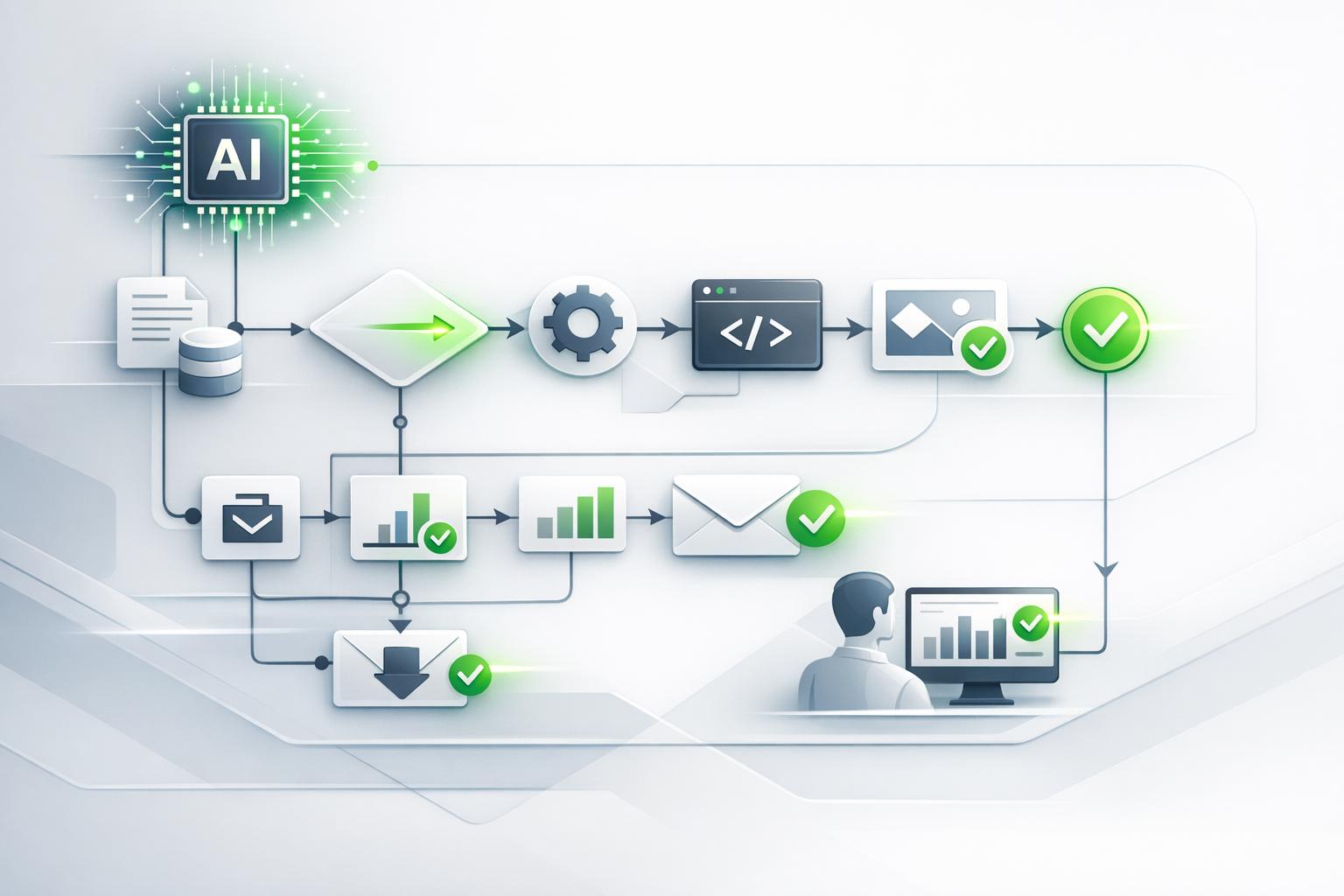
Predictive analytics helps businesses use historical data to forecast trends and make better decisions. ChatGPT simplifies this process with natural language prompts, eliminating the need for coding. From forecasting sales to predicting customer churn, here are seven ways ChatGPT can assist:
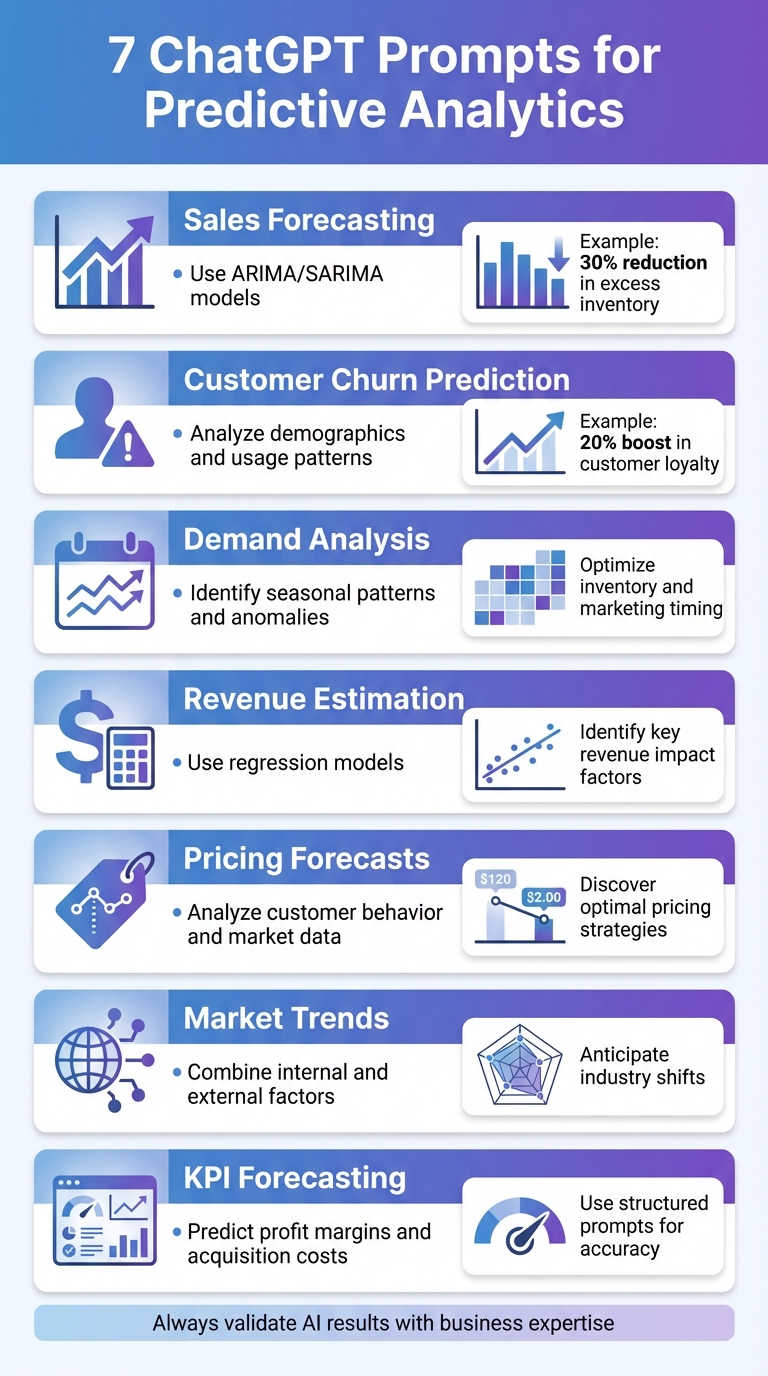
- Sales Forecasting: Upload sales data to predict future trends using models like ARIMA.
- Customer Churn Prediction: Analyze customer behavior to identify at-risk users and reduce churn.
- Demand Analysis: Spot seasonal patterns and anomalies to optimize inventory and marketing.
- Revenue Estimation: Use regression models to identify factors impacting revenue.
- Pricing Forecasts: Discover optimal pricing strategies based on customer behavior and market data.
- Market Trends: Combine internal data with external factors like policies and patents to anticipate industry shifts.
- KPI Forecasting: Predict metrics like profit margins or acquisition costs with structured prompts.
These prompts can turn raw data into actionable insights, helping businesses improve efficiency and make informed decisions. Always validate AI results with your expertise to ensure accuracy.
7 ChatGPT Prompts for Predictive Analytics Overview
ChatGPT for Data Analytics: Full Course
1. Forecasting Future Sales
You can use ChatGPT’s Data Analyst tool to forecast future sales by uploading your CSV historical data and asking it to apply models like ARIMA or SARIMA – no coding required [7][3]. This approach enables you to generate reliable, data-driven sales predictions.
Here’s a real-world example: In 2024, the Corporate Finance Institute utilized ChatGPT to forecast Tesla‘s quarterly revenue. Through iterative prompts, the model was fine-tuned to predict revenue for the next 12 quarters with impressive accuracy [7].
Another case involved a retail company that asked ChatGPT to "analyze sales history and suggest optimal stock levels for seasonal products." The result? A 30% reduction in excess inventory [2].
To get started, ask ChatGPT to visualize your data. This step can help you catch issues like reversed timelines or missing values early on. Then, request confidence intervals in the projections to account for market uncertainties [7]. These practices align with broader strategies in predictive analytics, where precision and flexibility are key.
That said, it’s crucial to validate AI-generated outputs with your own business expertise. As Thomas Young puts it:
AI Chat is a supercharged machine, but it still needs a driver to ensure it is used as a tool and not in place of a human [1].
2. Predicting Customer Churn
Customer churn analysis helps businesses understand how often customers stop using their product and uncovers the reasons behind it [11]. ChatGPT can process customer demographics, usage patterns, and feedback to identify individuals likely to churn [11]. This insight paves the way for creating targeted retention strategies.
For example, a SaaS company used ChatGPT to analyze customer data and pinpoint the factors causing churn. By implementing retention strategies based on this analysis, they boosted customer loyalty by 20% [2]. The process involved uploading structured historical data – such as customer profiles, usage trends, and support interactions – into GPT-4 for analysis [12].
To get started, consider asking questions like: "What are the main drivers of churn in our subscription model?" or "Which customer groups are most at risk of leaving?" [2][12].
Before analysis, ensure your data is clean and standardized [12]. Then, structure your prompts using SMART objectives (Specific, Measurable, Actionable, Relevant, Time-bound) for better results [4]. For example, you could ask: "Analyze why Enterprise customers with a lifetime value over $5,000 experienced a 15% decline in usage over the past three months."
As Tobias Zwingmann explains:
ChatGPT is a tool designed to work alongside you, augmenting your ability to perform your tasks efficiently [4].
In this role, the AI acts as a powerful analytical assistant, spotting trends and anomalies that might otherwise go unnoticed [5][4].
3. Analyzing Demand Trends
Understanding demand trends is crucial for businesses aiming to fine-tune inventory management and schedule marketing efforts effectively. With tools like ChatGPT, companies can dive into historical sales data to uncover seasonal patterns, cyclical behaviors, and unexpected anomalies that might indicate shifts in the market [3]. This process transforms raw data into actionable insights, equipping supply chain and marketing teams with the tools they need to respond strategically.
Take, for example, a manufacturing company that uploaded its structured CSV data and asked the AI to identify significant deviations in quarterly demand. The analysis uncovered a previously overlooked connection between regional economic indicators and product demand [3][6]. Armed with this knowledge, the company adjusted its production schedules ahead of time, aligning better with market needs.
To ensure accurate results, it’s essential to provide data with consistent time intervals. This data should include both internal metrics, like inventory turnover, and external factors, such as competitor pricing or broader economic trends [3][6]. A prompt like, "Analyze the monthly sales data to detect seasonal trends", or "Predict how seasonal trends will affect product sales next quarter", can serve as a starting point [2]. These analyses can be further enriched with visualizations, making it easier to interpret complex patterns.
ChatGPT can also create visual aids like heat maps and time-series plots, which help stakeholders quickly understand demand shifts [10]. After reviewing the initial analysis, businesses can refine their strategies by asking follow-up questions. For instance, you might ask, "Given these peak periods, what marketing tactics should we use to maximize revenue?" [2]. This step-by-step approach ensures that trend analysis leads to concrete actions.
As Daniel Pink aptly puts it:
Right answers are abundant, good questions are scarce, therefore they’re more valuable [1].
4. Estimating Revenue with Regression
Regression models take forecasting and trend analysis a step further by helping you understand how different variables influence revenue. With ChatGPT, you can identify which factors – like market volatility, pricing changes, or advertising budgets – have the greatest impact on your bottom line by analyzing these relationships [8].
To get the most out of regression modeling, it’s essential to be specific about the variables you want to include. For instance, instead of a broad query like "What will our future revenue look like?", try: "Build a regression model to predict future revenue based on historical sales data, current market volatility, and planned pricing strategies for the next six months." This level of detail allows ChatGPT to recommend the most suitable statistical approach, whether it’s simple linear regression for single-variable analysis or multiple regression to account for the interaction of several factors [2][8][14]. This specificity also aligns well with ChatGPT’s ability to clean and prepare data seamlessly.
ChatGPT is equipped to handle the messy realities of real-world data. It can automatically identify and fix data issues before running the analysis [8]. You can even ask it to merge datasets – for example, combining your sales records with external market reports – using shared identifiers to create a unified model [8]. Tobias Zwingmann, an analytics consultant, describes this collaborative process as:
ChatGPT is your co-pilot and you’re in the driver’s seat – a workflow I call augmented analytics [4].
Once the regression is complete, you can ask ChatGPT to break down the results into plain language. A prompt like "Explain these results in simple terms" can help you turn complex statistical outputs into clear, actionable insights [8][5]. To make these insights even more impactful, request visualizations like scatter plots or line graphs to illustrate how your sales correlate with key market variables [8][12]. By incorporating regression analysis into your overall strategy, you can make more informed, data-driven decisions that align with your business goals.
sbb-itb-7878072
5. Forecasting Optimal Pricing
Pricing can directly impact your revenue, and ChatGPT provides a useful tool for understanding how customers react to various price points. By combining customer profiles and purchase history (using identifiers like customer_id), you can uncover insights into customer price sensitivity [8]. This analysis goes beyond basic averages, offering a clearer picture of the connection between price changes and purchase behavior across different customer groups. This level of detail is essential for crafting precise prompts.
To make pricing forecasts effective, specificity is key. Instead of asking a broad question like "What should we charge?", try a more targeted prompt such as: "Analyze factors driving customer loyalty using past purchase and demographic data to identify upselling opportunities" [2]. You can also explore different pricing models with prompts like: "Evaluate a value-based pricing strategy based on market trends and customer feedback" [15]. ChatGPT can help you assess approaches like value-based pricing (what customers feel is worth paying), competitor-based pricing, and even psychological strategies like pricing at $9.99 versus $10.00 [15].
| Pricing Strategy | Focus | ChatGPT Application |
|---|---|---|
| Value-Based | Perceived customer value | Analyze customer segments and willingness to pay [15] |
| Competitor-Based | Market positioning | Benchmark internal prices against competitor data [15] |
| Dynamic Pricing | Demand and seasonality | Forecast price changes using time-series trends [3] |
| Psychological | Customer perception | Study how specific price points influence purchase volume [15] |
For more complex tasks, like calculating metrics such as LTV or ROAS, add the phrase "show your work step-by-step" to your prompts. This ensures transparency in calculations and reduces errors [13]. You can also run "what-if" scenarios, such as: "How would a 10% increase in customer retention affect our optimal price?" [13]. These sensitivity analyses help you understand how even small changes in customer behavior can shift your pricing strategy. Always remember to anonymize data to protect customer privacy [13].
6. Predicting Market Trends
Predicting market trends with ChatGPT goes beyond just analyzing your internal data. It involves incorporating external factors like government policies, patents, startup funding rounds, and industry whitepapers to get a broader perspective [16]. This approach helps you identify potential disruptions before they hit your business. To make the most of ChatGPT, structure your prompts carefully – define a role, outline a specific task, provide clear instructions, and include the necessary context.
Start with role-play to guide the AI: "Act as a market research analyst. Review recent news articles, government policies, and industry whitepapers related to [Industry Name] from the past 12 months. Identify regulatory changes, shifts in market demand, and notable industry developments. How are these changes impacting businesses in this sector, and what trends can we expect in the future?" [16]. This method ensures the AI focuses on the direction and magnitude of trends over a defined period, avoiding generic responses. It also complements the internal data analysis techniques discussed earlier by adding critical external context to your models.
For industries driven by technology, you can target innovation signals with a prompt like: "Analyze recent patents, research papers, startup funding rounds, and product launches in the [Industry Name] space. Identify major technological advancements and potential disruptions. How might these innovations affect current market leaders?" [16]. This type of inquiry highlights emerging opportunities and competitive threats, offering insights that traditional methods might overlook. It builds on earlier discussions of regression and demand trend analysis to provide a more comprehensive picture.
To make predictions actionable, request structured outputs in formats like tables or SMART objectives [17]. If the results seem too broad, refine them with follow-up prompts like: "Make this more technical" or "Identify data gaps that could impact the analysis" [17]. For better accuracy, cross-check AI-generated insights with tools like Google Trends or industry reports to address potential data delays [16]. This process strengthens your forecasting foundation and helps you monitor key performance indicators effectively.
As Mark Cuban famously said:
There’s two types of companies: those who are great at AI and everybody else [9].
7. Forecasting Key Performance Indicators
Predicting KPIs like profit margins or customer acquisition costs hinges on having well-structured data and crafting effective prompts. ChatGPT can analyze relationships between variables, such as the impact of marketing spend on customer acquisition, to provide insights into future costs and efficiencies [2]. For time-series data, it identifies patterns, trends, and seasonal fluctuations to make accurate KPI forecasts [3].
To get the most out of ChatGPT, structuring your prompt is essential. Begin by assigning a specific role to ChatGPT, such as: "Act as a top-tier analytics consultant. Analyze the relationship between marketing spend and customer acquisition based on the following historical data: [insert data]. Identify key factors driving fluctuations and forecast customer acquisition costs for the next quarter." [2][4]. This method directs the AI to focus on the aspects that are most relevant to your business goals.
Data preparation is just as important as the prompt. Clean and organize your data before using it. For instance, a retail company leveraging ChatGPT for inventory forecasting reduced excess stock by 30%, while a SaaS company improved customer retention by 20% by identifying churn factors through AI analysis [2]. Iteratively refining your prompts can also enhance the accuracy of predictions [2].
For more complex KPIs, breaking them down into smaller components using the MECE principle (Mutually Exclusive and Collectively Exhaustive) can be helpful. This involves creating "Issue Trees" to map out all potential drivers without overlap [4]. Additionally, translating vague objectives into SMART (Specific, Measurable, Achievable, Relevant, Time-bound) goals before forecasting ensures clarity and precision [4]. Research indicates that using narrative prompts with future-set scenarios can improve forecasting accuracy compared to straightforward prediction questions [18].
As Tobias Zwingmann, an expert in AI for analytics, explains:
The most powerful use of ChatGPT in data analysis is to use it before data analysis begins [4].
Just like with earlier forecasting techniques, visual aids can play a critical role in communicating insights. Use tables or charts to present forecasted KPIs in a way that’s easy for stakeholders to understand [12][9]. Always validate predictions against your business context to ensure they align with real-world conditions. These methods fit seamlessly into a broader AI strategy, which will be explored in the next section.
Integrating Prompts into Business AI Strategy
When it comes to using ChatGPT prompts for predictive analytics, the key is treating AI as a co-pilot rather than a replacement for human expertise [4]. Before diving into your data, use ChatGPT to create SMART problem statements – Specific, Measurable, Actionable, Relevant, and Time-bound – and to break down complex challenges with MECE frameworks (Mutually Exclusive and Collectively Exhaustive) [4]. Laying this groundwork ensures your analysis is aimed at the right business questions from the outset, setting the stage for smarter workforce and process improvements.
Take Patrick Patterson, President of Level Agency, as an example. In 2023, he focused on upskilling his team to tailor AI technologies to their needs. By feeding ChatGPT specific data and requesting professional biographies crafted with best practices, his agency achieved far better results than simply using AI as a search tool [1]. This method reflects a growing trend in how businesses are strategically leveraging AI [1].
For more actionable advice, Lasse Rouhiainen’s book, "ChatGPT – 101 Things You Must Know Today About ChatGPT and Generative AI," provides practical frameworks. It covers everything from prompt engineering to addressing data bias, offering valuable tools to enhance predictive analytics [13][2].
If you’re looking to deepen your expertise, the 90-day AI Consultant Accelerator program on Artificial Intelligence Keynote Speaker is worth exploring. This program tackles a common challenge: while AI technology evolves rapidly, many executives struggle to fully harness its potential. The accelerator offers personalized mentoring, hands-on projects, and guidance on developing client-ready AI assistants, helping participants transition from basic prompt users to skilled AI consultants [1].
Mike Foster, Founder of The Foster Institute, emphasizes the urgency of this shift:
AI is growing exponentially while our ability to harness its power lags far behind. Executives must embrace the technology before their competitors do [1].
To stay ahead, adopt a scientist’s mindset: take action, adjust as needed, and experiment with small-scale prompts to uncover competitive advantages [1].
Conclusion
These seven prompts break down predictive analytics, turning what might seem like an overwhelming task into a practical, decision-making tool for everyday use. Real-world examples back up their effectiveness, showing how they can deliver meaningful results [2].
The key to success lies in combining ChatGPT with your own expertise. As Tobias Zwingmann, an AI for Analytics Expert, aptly points out:
ChatGPT is not the better data analyst, but… it works best when doing the work with you – getting faster outputs, improving quality, and serving as a second pair of eyes to eliminate blind spots [4].
Crafting clear, structured prompts is essential, and fine-tuning them through follow-ups ensures even better outcomes [2].
While AI excels at uncovering complex patterns, your judgment is still crucial for making strategic decisions. Always double-check AI-generated forecasts by comparing them with actual data [2].
These methods not only enhance decision-making but also open doors for professional growth. To take your skills further, structured training can make a big difference. For example, the 90-day AI Consultant Accelerator offered by Artificial Intelligence Keynote Speaker provides advanced techniques like Chain-of-Thought prompting and role-based frameworks. With 63% of business leaders planning to increase their AI investments over the next three years [19], now is the time to sharpen your expertise and lead the way in predictive analytics.
FAQs
How can ChatGPT help improve the accuracy of sales forecasts?
ChatGPT can improve the accuracy of sales forecasting by diving into historical sales data to uncover patterns, seasonal trends, and unexpected anomalies. It can suggest suitable forecasting models and empower users to run quick scenario and sensitivity analyses with customized prompts. This helps businesses make sharper, data-driven predictions, streamlining their decision-making and planning efforts.
How can I effectively use ChatGPT for customer churn analysis?
To get the most out of ChatGPT for customer churn analysis, start by defining your specific objective. Are you trying to pinpoint customers at risk of leaving, identify the main reasons behind churn, or develop strategies to improve retention? Providing clear details, like the department involved (e.g., customer success) and the time frame for analysis, will help ChatGPT generate more focused and actionable insights.
Next, make sure you have a well-prepared dataset. Historical customer data is key, and it should include metrics like usage patterns, customer demographics, and prior churn behavior. Before using the data, clean it thoroughly to eliminate errors and ensure privacy by anonymizing sensitive information. When asking ChatGPT for analysis methods, be specific about your dataset’s features so it can recommend techniques like logistic regression or decision trees that align with your data.
Lastly, think of ChatGPT as a supporting tool, not a standalone solution. Use it to draft reports, highlight trends, and propose action plans, but always cross-check its outputs with expert analysis and statistical validation. Continuously refine your prompts and compare its suggestions against traditional models to ensure reliability. For additional ideas on leveraging AI in business, consider exploring workshops or consulting services, such as those offered by the Artificial Intelligence Keynote Speaker site.
How does ChatGPT ensure data privacy when analyzing market trends?
ChatGPT takes your data privacy seriously and provides options to help you stay in control. For instance, you can turn off the “Improve the model for everyone” setting, which ensures your inputs – like prompts for analyzing market trends – aren’t saved for model training. You can also switch to a temporary chat mode for an extra layer of privacy. To keep your information secure, it’s best to avoid sharing anything sensitive or confidential.