Competitor analysis is critical for staying ahead in any market. Using tools like ChatGPT can simplify this process, turning weeks of manual research into minutes of actionable insights. Here’s how ChatGPT helps:
- Identify Competitors: Categorize rivals into direct (Tier 1), indirect (Tier 2), and adjacent threats (Tier 3).
- Create Detailed Profiles: Summarize competitors’ products, pricing, marketing, and customer feedback.
- Perform SWOT Analysis: Break down strengths, weaknesses, opportunities, and threats for each competitor.
- Analyze Marketing Strategy: Evaluate social media, content themes, and SEO performance.
- Compare Products and Pricing: Highlight gaps in features and pricing models.
- Understand Customer Sentiment: Summarize reviews to spot trends and unmet needs.
With clear prompts and tailored inputs, ChatGPT can organize data, uncover patterns, and provide insights to refine your strategy. Always verify AI findings with up-to-date data for accuracy. This guide walks you through the setup, techniques, and advanced methods to make competitor analysis a faster, more effective process.
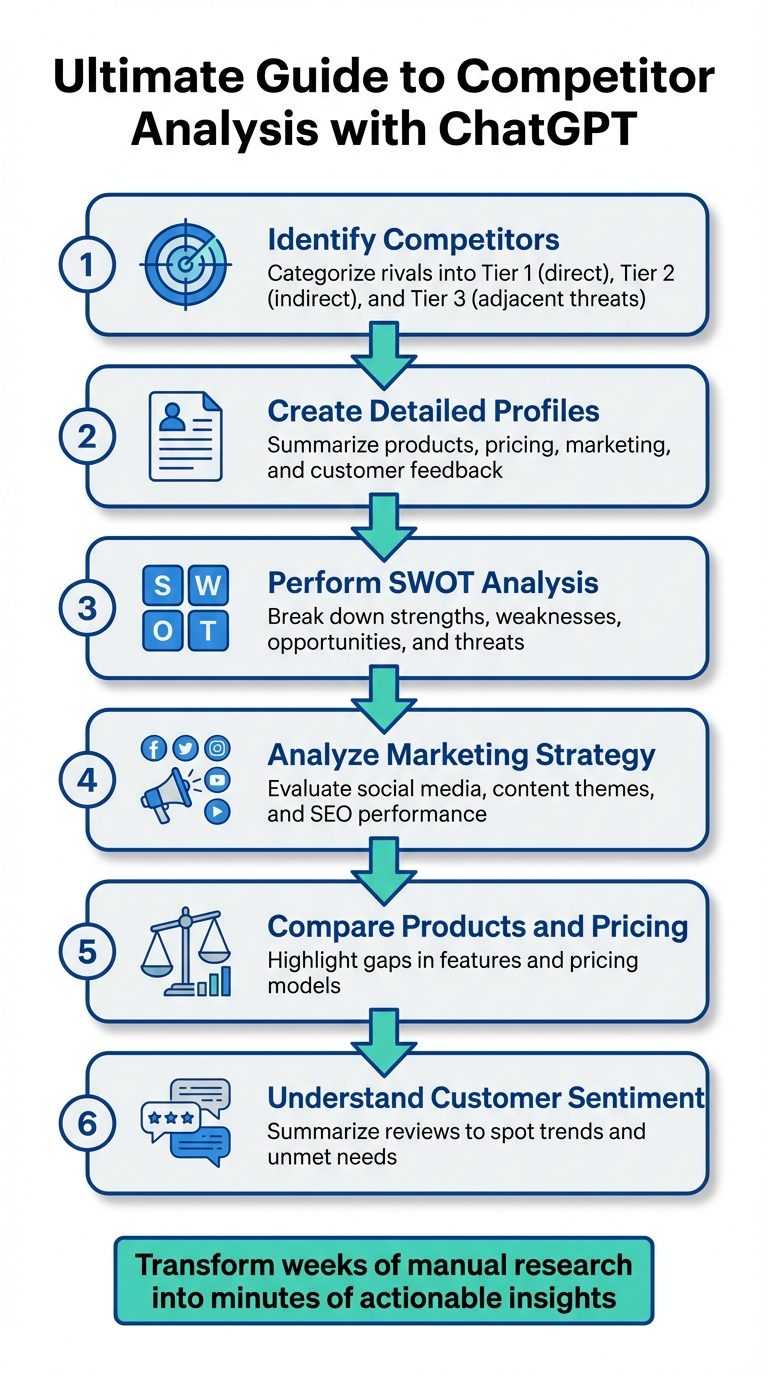
6-Step ChatGPT Competitor Analysis Process
How to Use ChatGPT Agent (2025): Competitor & Market Research + Excel (Step-by-Step)
Setting Up ChatGPT for Competitor Analysis
Getting ChatGPT to provide meaningful competitor insights hinges on how well you configure it upfront. A little effort in setup can mean the difference between vague results and actionable intelligence.
Customizing ChatGPT for Research
Think of ChatGPT as a new analyst on your team. To get the best results, you need to clearly define its role and expectations. Start by assigning it a persona. For example, instruct ChatGPT to act as a "senior competitive-intelligence strategist" to ensure its responses are both strategic and professional. This simple tweak can shift the focus from generic answers to well-thought-out insights.
Next, provide detailed context about your business. ChatGPT performs better when it understands your company’s unique position. Instead of asking, "Who are my competitors?", give it specifics like: "I operate a B2B SaaS platform for HR automation targeting mid-market companies in the Northeast United States. Identify my top competitors." This level of detail helps the AI generate more relevant and precise results.
To address ChatGPT’s knowledge cutoff, you can upload up-to-date resources like competitor sitemaps, market reports, or customer reviews. This ensures the AI has access to current data and isn’t working with outdated information. You can also customize its behavior by setting instructions to cite sources with hyperlinks or explicitly state when data is missing, reducing the risk of incorrect guesses.
Finally, define how you want the output structured. For example, you can request that ChatGPT use headings, bullet points, and specific time references like "Q4 2025" instead of vague terms like "last quarter." This makes the information easier to digest and share with stakeholders.
| Customization Element | Purpose | Example Instruction |
|---|---|---|
| Persona | Sets the expertise level | "You are a senior competitive-intelligence strategist." |
| Objective | Clarifies the goal | "Map the competitive landscape, including emerging players." |
| Data Source | Provides fresh context | "Analyze the following competitor reports…" |
| Constraints | Ensures accuracy | "Use specific dates (e.g., June 2025) and cite all claims." |
| Format | Organizes output | "Deliver a structured report with an Executive Summary and SWOT analysis." |
Once ChatGPT is customized, you’re ready to dive into competitor analysis by crafting effective initial prompts.
Using Initial Prompts to Identify Competitors
With ChatGPT set up, your first step is identifying your competitors. A tiered approach works best, categorizing rivals into three levels: Tier 1 (direct competitors offering the same product), Tier 2 (close substitutes solving the same problem differently), and Tier 3 (adjacent threats or emerging players). This ensures you cover both direct and indirect competition.
Start with a broad landscape-mapping prompt that includes your role, company details, and industry context. For example: "I am a Marketing Director at [Company Name]. Generate a competitor overview for businesses offering [Product/Service] in the [Industry]. Include direct and indirect competitors." This helps establish a comprehensive view before narrowing the focus.
To uncover competitors that might not be immediately obvious, ask ChatGPT to analyze recent funding announcements, app store listings, or industry news. For instance, you could say: "Use recent news, app store activity, and funding announcements to identify additional players addressing [Job-to-be-Done]. Rank them by Tier 1, 2, and 3 relevance." This approach is particularly useful for spotting startups or emerging threats early.
Once you have an initial list, refine your research with targeted follow-ups. For example, you can narrow the analysis to specific regions like "compare only EU-based competitors" or focus on particular aspects such as pricing strategies or product features. This iterative process ensures you capture all key players while keeping the analysis focused and manageable. Always cross-check ChatGPT’s findings with trusted analytics tools for accuracy.
Creating Competitor Overviews and SWOT Analysis
After identifying your competitors, the next logical step is to build detailed profiles that give insight into their operations and market position. This is where ChatGPT shines – it can take scattered bits of information and organize them into structured, easy-to-digest overviews. Once those profiles are ready, a SWOT analysis adds another layer of clarity, helping you understand each competitor’s strategic standing.
Generating Competitor Profiles
A well-rounded competitor profile should include key details like the company’s background, product offerings, target customers, pricing strategy, marketing approach, and overall market traction. ChatGPT can help synthesize this data into a single, structured document.
For best results, provide ChatGPT with specific data points. For instance, you might ask:
"Create a competitor profile for [Company Name]. Include information such as their headquarters location, founding year, last funding round, employee count, key executives, product features, target audience, pricing plans, marketing channels, customer numbers, and app store ratings."
The more detailed your request, the more organized and comprehensive the output will be.
If you’re working with information beyond ChatGPT’s knowledge cutoff, use tools like the "Browse with Bing" feature or upload recent documents such as annual reports, press releases, or competitor sitemaps. This ensures the AI is working with the most current data. You can also paste customer reviews directly into ChatGPT – grab 30 to 100 reviews from platforms like the Google Play Store or Amazon – and ask it to "summarize the top 5 things users appreciate and the top 5 complaints." This turns raw feedback into actionable insights that can guide your analysis.
For direct competitors (Tier 1), aim for in-depth profiles. For indirect competitors (Tier 2 and Tier 3), lighter overviews will suffice. This tiered approach not only helps you manage ChatGPT’s token limits but also keeps your focus on the most critical players in your market.
Performing a SWOT Analysis
A SWOT analysis – breaking down a competitor’s Strengths, Weaknesses, Opportunities, and Threats – is a powerful way to pinpoint areas where your business can gain an edge. ChatGPT can streamline this process, especially when you provide clear objectives and up-to-date data.
Use a specific prompt like:
"Conduct a SWOT analysis for [Competitor Name]. Focus on their product offerings, market reach, customer feedback from app store reviews, and pricing strategies. My goal is to identify market gaps for a product launch in Q2 2026."
By outlining exactly what you’re looking for, you ensure the analysis stays relevant and actionable.
To take things a step further, ask ChatGPT to create a comparison table that benchmarks multiple competitors side by side. This table can highlight differences in product features, pricing models, marketing strategies, and customer sentiment metrics like Net Promoter Scores (NPS) or app store ratings. For example, if you’re analyzing three SaaS companies, the table might reveal which competitor struggles with mobile app performance (an opportunity) or which one dominates SEO rankings (a potential threat).
This structured approach helps you uncover insights that can shape your strategy and give you an edge in the market.
Analyzing Marketing Strategies and Content Performance
After building competitor profiles and conducting SWOT analyses, the next logical step is to figure out how your competitors are connecting with their audience. This involves dissecting their marketing strategies – everything from social media activity to content themes and SEO approaches. By leveraging tools like ChatGPT, you can turn mountains of marketing data into clear, actionable insights about what works and what doesn’t. This section focuses on breaking down competitors’ marketing tactics to help refine your own strategies.
Evaluating Social Media and Messaging Tactics
Social media is one of the most powerful tools for engaging audiences. With billions of users globally [3], it’s crucial to understand where your competitors are active and how effectively they’re performing. ChatGPT can streamline this analysis by examining posting frequency, engagement rates, messaging styles, and platform-specific strategies.
For instance, you might use a prompt like:
"Analyze the top five competitor brands on TikTok and LinkedIn for engagement rate, sentiment, and post cadence. Summarize strengths, weaknesses, opportunities, and threats in a 4-cell table."
This structured approach helps generate organized, easy-to-compare results. You can also feed ChatGPT recent user comments or captions to identify recurring themes in positive and negative feedback.
To track performance across platforms, consider using a comparison table to benchmark key metrics:
| Metric | ChatGPT Prompt Focus | Insight Gained |
|---|---|---|
| Posting Frequency | "Analyze post cadence over the last 30 days" | Reveals how often competitors post and their most active days |
| Messaging Themes | "Summarize core value propositions and tone" | Highlights how competitors differentiate their messaging |
| Engagement Rates | "Compare engagement velocity across platforms" | Identifies which platforms (e.g., TikTok or LinkedIn) drive the most interaction |
| Content Gaps | "Identify topics with high demand but low brand activity" | Pinpoints areas where your content strategy can stand out |
These insights build on competitor profiles by focusing on real-time engagement trends. It’s also worth noting that one in five U.S. adults now gets news from influencers instead of traditional media outlets [3]. This means your competition isn’t just other brands but also individual creators. Analyzing both can provide a more comprehensive view of the competitive landscape.
"AI = Analyst, Human = Strategist." – Berfin Cezim, Content Strategist [3]
Once you’ve analyzed social media strategies, the next step is to dive into competitors’ content and SEO efforts to round out your market analysis.
Assessing Content Themes and SEO Strategies
Competitors’ content and SEO strategies can reveal a lot about their positioning and authority in the market. ChatGPT can help you break these down by examining content themes, keyword usage, and search intent.
For example, you might ask:
"Analyze the blog content published by [competitor] over the past six months. What key themes and topics are they covering? How effectively do they position themselves as a thought leader in [industry]?"
This kind of analysis can uncover their main content pillars and highlight opportunities for you to fill gaps in your own strategy.
For SEO, tools like Semrush or Ahrefs can provide valuable data to feed into ChatGPT. Export a competitor’s keyword list and use a prompt like:
"Identify ‘missing’ or ‘untapped’ keywords – terms that [competitor] ranks for but we do not. Prioritize by search volume and relevance."
This can help you discover high-value keywords to target and capture traffic your competitors currently dominate.
You can also use ChatGPT to evaluate technical SEO elements. For instance, you might request:
"Analyze [competitor’s] title tags, meta descriptions, and schema.org usage. Identify opportunities to improve click-through rates and search engine understanding."
Additionally, exploring voice search readiness – by checking if competitors optimize for conversational, long-tail phrases like "How do I use [product capability]?" – can reveal untapped opportunities. Another useful tactic is analyzing whether competitor content addresses different user intents (informational, navigational, or transactional). This can help you refine your content to better meet user needs and stand out in search results.
sbb-itb-7878072
Product, Pricing, and Customer Sentiment Analysis
After exploring marketing strategies, it’s time to dig into product features, pricing models, and customer sentiment. ChatGPT can take complex data – like product specs, pricing tiers, and customer feedback – and turn it into clear, actionable insights. This helps you identify market gaps and refine your competitive edge.
Feature-by-Feature Product Comparisons
To understand how your product stacks up, compare its features against competitors. ChatGPT can analyze data from competitor websites – like product details, feature lists, and even patents – to pinpoint what’s standard in the industry and what’s genuinely different. This can uncover opportunities where your product shines or areas where you might need to improve.
Here’s a useful prompt to guide the analysis:
"Compare the following list of product features and identify which are unique to each product versus which are table stakes across the industry."
This approach helps you zero in on your Unique Selling Proposition (USP) by evaluating competitors’ marketing claims for originality and relevance. You can even request a "Blue-Ocean" or white-space matrix to visualize where your product fits in the competitive landscape.
| Analysis Type | ChatGPT Input Required | Expected Output |
|---|---|---|
| Feature Comparison | Competitor product descriptions and spec sheets | Matrix of unique vs. common features |
| USP Identification | Competitor messaging and value propositions | Analysis of distinctiveness and market relevance |
AI tools like ChatGPT are widely used in marketing because they streamline competitive analysis. Start with a broad overview of the market, then refine your focus with follow-up prompts, such as "compare only competitors in North America" or "analyze feature sets for emerging players."
Once you’ve mapped the features, the next step is to dive into competitors’ pricing strategies.
Analyzing Pricing Strategies
Pricing plays a huge role in market positioning. By studying how competitors price their products, you can identify opportunities to stand out – whether by offering better value or targeting a different segment. ChatGPT can analyze public pricing tiers and categorize competitors as "cost leaders" or "premium brands." It can also evaluate pricing models, such as cost-based (driven by production costs), value-based (focused on perceived value), or competitor-based (relative to market standards).
Here’s a sample prompt to guide pricing analysis:
"Analyze these competitor pricing tiers and identify standard discounts, bundled pricing, and any dynamic variances like seasonal offers. Who is positioning as premium versus budget-friendly?"
For the most meaningful insights, focus on a small group of 3–5 key competitors that pose the biggest threat to your market share.
"Competitive pricing analysis examines how your prices stack up against competitors’ pricing to inform smarter pricing decisions." – PriceIntelGuru [4]
ChatGPT can also break down pricing structures into individual components to show how competitors build their offers. However, it’s essential to cross-check these findings with real-time data sources, as ChatGPT relies on pre-existing knowledge and may not account for recent updates.
With pricing strategies clarified, the final step is to analyze customer sentiment for deeper insights.
Understanding Customer Sentiment
Customer feedback is a treasure trove of unfiltered opinions about what’s working – and what’s not. ChatGPT can process thousands of reviews from platforms like Google Play or Amazon to identify recurring themes. This kind of analysis, which might take days manually, can be done in minutes.
To get started, try this prompt:
"Analyze these customer reviews and summarize the common positive and negative points into a SWOT table."
This method helps you spot areas where competitors are falling short, allowing you to position your product as a better alternative. For example, by focusing on negative reviews, you can discover pain points that your product is uniquely positioned to solve.
When preparing your data, remove developer responses and unrelated text to ensure ChatGPT focuses solely on user feedback. Start by asking for the top 5 "pros" from 5-star reviews, then explore the top 5 "cons" from 1–4 star reviews to get a balanced perspective. Keep in mind that AI might struggle with nuances like sarcasm or humor, so always validate its findings with other tools or manual checks.
Advanced Techniques for Competitor Insights
Once you’ve mastered the basics, it’s time to take your competitor analysis to the next level. By using advanced techniques like iterative prompting and tailoring ChatGPT to your specific industry, you can transform basic findings into deeper, strategic insights. These methods not only help you spot patterns that might go unnoticed in manual analysis but also connect data points from various sources to form a clearer picture of the competitive landscape.
Think of ChatGPT as a strategic collaborator, not just a tool for one-off answers. By refining your questions and linking analyses, you can uncover not only what your competitors are doing but also why they’re doing it and where they may be vulnerable. Building on foundational techniques like competitor mapping, these advanced approaches let you dig deeper and extract actionable insights.
Iterative Prompting and Chaining Analyses
Iterative prompting is a step-by-step process where you start with a broad question and progressively narrow your focus with follow-up queries. For instance, you might begin with, "Who are the top 5 competitors in the AI consulting space?" and then refine the scope with prompts like, "Compare only EU-based competitors from that list" or "Analyze the pricing strategies of the top three." This guided approach allows for a more precise and layered analysis.
To take it further, use Socratic questioning. Ask probing questions like, "Why is Competitor X excelling in innovation?" followed by, "What evidence points to weaknesses in their customer service?" This method encourages the AI to explore different angles and uncover insights you might not have considered.
Another effective tactic is data chaining. For example, if you’re analyzing customer sentiment, feed ChatGPT batches of 30–100 reviews in stages. Start by extracting positive themes from high-rated reviews, then analyze criticisms from lower-rated ones. This layered approach helps you build a balanced SWOT analysis while staying within the AI’s token limits. The result? A clearer picture of strengths, weaknesses, opportunities, and threats, synthesized into actionable strategies.
"Analysis is an iterative process. You may need to refine your questions or provide more data to get the most accurate insights." – Elena, Author, Mesh Firm
For example, you can combine competitor profiles with analytical frameworks to uncover deeper insights. Conduct a SWOT analysis on a competitor, then validate their listed strengths by cross-referencing customer feedback. Similarly, link pricing analysis with sentiment data to determine whether customers see a competitor’s premium pricing as justified or excessive. A practical workflow might look like this: identify competitors → create SWOT profiles → analyze customer sentiment → build a competitive positioning map. What might take weeks manually can be streamlined significantly with these techniques.
Customizing ChatGPT for Specific Industries
While general methods are helpful, tailoring ChatGPT to your industry makes the insights far more relevant. Generic prompts lead to generic results. To get industry-specific insights, provide ChatGPT with detailed context. Start by assigning it a role – like "senior competitive intelligence strategist for SaaS companies" or "expert in AI consulting market analysis" – to set the tone and depth of the responses. Then, include details about your company, such as your unique value proposition, target market, and geographic focus. For instance, you could say, "Our company provides AI consulting services to mid-sized B2B firms in North America, specializing in ChatGPT implementation. Analyze competitors targeting the same market." This approach ensures the AI’s analysis is grounded in your specific business environment.
Customize prompts to emphasize sector-specific factors. For SaaS companies, focus on feature comparisons and API integrations. In e-commerce, highlight pricing dynamics and shipping feedback. For AI consulting, dive into competitors’ technology stacks and their thought leadership strategies. Fintech firms could use frameworks like Porter’s Five Forces to evaluate regulatory challenges and customer bargaining power, while content creators might focus on platform algorithms and audience engagement.
Another advanced technique is a first-principles breakdown. Ask ChatGPT to deconstruct a competitor’s offerings into core elements like user interface, pricing, and content, then recombine those elements to identify areas for improvement.
To avoid ambiguity, always define specific dates in your prompts. For example, a query like, "Assume today is January 2, 2026", ensures that references to "last quarter" or "next year" are interpreted correctly. You can also manage token limits by requesting tiered summaries: detailed profiles for direct competitors and brief overviews for adjacent threats. Finally, instruct the model to cite every statistic or claim, so you can verify accuracy.
"The only sustainable competitive advantage is to learn faster than your competition and to be able to act on what you have learned." – Jack Welch, Former CEO, General Electric
Keep in mind that ChatGPT’s knowledge is limited by its cutoff date and may produce inaccuracies if industry-specific details aren’t provided. Always cross-check financial data, pricing, and feature specifics against up-to-date sources. By applying these advanced techniques, you can continuously refine your competitive strategy and stay ahead of the game.
Turning Insights into Business Strategies
Turn competitor analysis into actionable strategies that can drive your business forward. Building on your earlier competitor profiles and SWOT analyses, ensure every AI-generated insight is verified before putting it into action.
"LLMs don’t win competitive deals – they need a system to verify and validate insights." – Adam Houghton, VP of Product at Klue
The best strategies come from a blend of three key elements: AI for speed and pattern recognition, verified analytics tools for accuracy, and human judgment for intuition and storytelling. This combination ensures your decisions are based on solid data while staying grounded in market realities. For example, double-check pricing, features, and market positioning using trusted sources before acting on AI outputs. If you’re looking for more structured guidance, Lasse Rouhiainen’s book ChatGPT – 101 Things You Must Know Today About ChatGPT and Generative AI provides practical frameworks for applying generative AI across various business scenarios.
Once your insights are validated, the next step is to organize them into concise, actionable reports.
Building Reports for Decision-Making
Create reports that help decision-makers act with confidence. Start with a brief executive summary – keep it under 250 words – highlighting the most important findings and suggested next steps. Follow this with a competitive landscape map that outlines direct, indirect, and emerging competitors. Include detailed profiles of your top three competitors, covering their headquarters, product offerings, pricing models, and go-to-market strategies.
Use comparative tables to make differences between competitors clear. For instance, if your analysis shows competitors prioritize low pricing but neglect customer service, your table should make this gap obvious. Add a synthesis section summarizing market gaps, SWOT insights, and frameworks like Porter’s Five Forces to provide a comprehensive view.
| Report Section | Content Description |
|---|---|
| Executive Summary | A concise overview of findings and strategic recommendations (≤250 words) |
| Landscape Map | A table or list of direct, indirect, and emerging competitors |
| In-depth Profiles | Detailed breakdown of key competitors (HQ, product lineup, pricing, GTM strategies) |
| Comparative Tables | Side-by-side comparisons of pricing, features, and messaging |
| Key Insights | Analysis of market gaps, SWOT summaries, and strategic frameworks |
| Recommendations | 3–5 actionable steps ranked by impact and feasibility |
End your report with 3–5 ranked recommendations. These should be specific and actionable, such as "introduce real-time chat support to address weaknesses in competitor customer service" or "target mid-sized healthcare firms overlooked by Competitor X." Use iterative prompting during your analysis to refine insights and maintain depth.
With these reports in hand, you’ll be ready to uncover untapped opportunities in the market.
Identifying Gaps and Opportunities
Focus on areas where competitors fall short. Use ChatGPT to pinpoint gaps in underserved customer segments, missing product features, or weak post-purchase support. For example, analyzing customer reviews – comparing 5-star reviews with 1-4 star reviews – can highlight recurring complaints like slow response times or missing integrations, which could signal opportunities to stand out.
Leverage the "Value Wedge" concept to identify competitive advantages. Ask ChatGPT to break down a competitor’s offering into elements like user interface, pricing, support, and delivery speed. Then, explore ways to reassemble those elements into a more appealing package. For instance, if competitors bundle features customers don’t need, you could offer à la carte pricing for better perceived value.
Blue Ocean mapping is another powerful tool for spotting untapped opportunities. Define two strategic dimensions – like price and feature breadth – and ask ChatGPT to map where competitors cluster. Empty spaces on the map could represent potential growth areas. Netflix’s pivot from DVD rentals to streaming in 2007 is a classic example of identifying and capitalizing on such a gap, leaving competitors like Blockbuster behind [2].
You can also uncover niche targeting opportunities by analyzing competitor data for overlooked customer groups. If your competitors focus on enterprise clients, you might dominate the mid-market by tailoring your messaging, pricing, and features to companies with 50–200 employees. Similarly, if sentiment analysis shows competitors are viewed as "outdated", position your brand as modern and dynamic to attract customers looking for something fresh.
Finally, turn insights into immediate action by reviewing sales transcripts. Upload call recordings or notes to ChatGPT and identify recurring objections related to competitors. For instance, if prospects frequently mention that Competitor Y’s onboarding process is slow, adjust your messaging to highlight your faster, more efficient setup. This transforms your analysis into actionable talking points that your sales team can use right away.
Conclusion
ChatGPT transforms competitor analysis from a weeks-long process into a task that can be completed in minutes. Traditional methods often relied on static reports that were outdated by the time they reached decision-makers. In contrast, AI-powered tools like ChatGPT provide real-time insights, analyze thousands of data points, and reveal hidden patterns in competitor strategies [1][5]. With nearly 85% of marketers already incorporating AI into their workflows to boost efficiency and automate tasks, this shift from static reports to dynamic intelligence has become critical for maintaining a competitive edge [2]. However, while speed is a clear advantage, it’s crucial to verify AI-generated insights before acting on them.
Think of ChatGPT as your starting point for analysis, not the final word. Always validate its findings using trusted analytics tools and cross-check details like pricing, features, and market positioning. Craft specific prompts to narrow down insights by timeframe, platform, or metric. For example, analyzing customer reviews can help you uncover unmet needs or weaknesses in competitor offerings. Once verified, turn these insights into ranked, actionable steps your team can execute immediately.
Despite its potential, over 50% of professionals remain hesitant to adopt AI due to concerns about knowledge gaps or security risks [2]. Resources like Lasse Rouhiainen’s book, ChatGPT – 101 Things You Must Know Today About ChatGPT and Generative AI, offer practical strategies for using generative AI in business. For those looking to deepen their expertise, Rouhiainen’s 90-day AI Consultant Accelerator provides hands-on mentoring to develop advanced AI skills and deliver impactful solutions.
FAQs
How can I customize ChatGPT for competitor analysis?
To fine-tune ChatGPT for competitor analysis, start by customizing its knowledge base to align with your market. Collect and organize data from sources like competitor websites, product specs, pricing details, social media content, and customer feedback. This information helps the model grasp your industry’s language and nuances. You can also embed industry reports or summaries into the model’s instructions to improve its understanding.
Next, tailor the model’s behavior to deliver the specific insights you need. Whether it’s market positioning, pricing trends, or SWOT analysis, clearly define the type of analysis and the preferred output format (e.g., bullet points or comparison tables). Providing example questions and sample responses can help ensure the output is clear, relevant, and actionable.
Finally, develop reusable prompts that combine your tailored data with real-time queries. For example, you might ask, “How do Competitor A and Competitor B differ in their pricing strategies over the past six months?” Additionally, integrating ChatGPT with tools like spreadsheets or dashboards can make data analysis faster and more efficient. For deeper insights, explore workshops or resources that focus on using ChatGPT for business intelligence.
How can ChatGPT enhance a SWOT analysis?
ChatGPT can streamline the process of creating a SWOT (Strengths, Weaknesses, Opportunities, Threats) analysis by efficiently processing and organizing vast amounts of public data, such as customer feedback, market trends, and social media activity. This means businesses can craft a detailed and structured SWOT matrix much faster than traditional manual methods.
What sets ChatGPT apart is its ability to maintain consistency and neutrality. By following a standardized analytical approach, it can pinpoint strengths like standout product features, identify weaknesses such as pricing disadvantages, uncover opportunities in emerging markets, and flag threats like rising competition – all tailored to the specific needs of the business.
Another advantage is its adaptability. Professionals can fine-tune their analysis on the fly, incorporating new information or testing different scenarios without starting from scratch. For those eager to maximize the tool’s potential, there are workshops and guides available that focus on integrating ChatGPT into business strategy development.
How can ChatGPT help identify gaps in your competitors’ strategies?
ChatGPT can examine publicly available competitor information – like pricing structures, marketing strategies, distribution methods, or campaign results – and compare it with your own business tactics. This analysis can pinpoint areas where competitors might be falling short or missing out on opportunities.
For instance, it might identify pricing inefficiencies, content gaps, or neglected sales channels, giving you the chance to tweak your strategy and gain an edge. It’s a practical tool for fine-tuning your approach and staying ahead in your market.