AI is reshaping marketing by driving efficiency, personalization, and better decision-making. Over 80% of marketers already use AI, helping businesses increase efficiency by 20–30% and double conversion rates. Companies like Netflix and Amazon save billions through AI-driven recommendations. Generative AI tools like ChatGPT create content in minutes, while predictive analytics enable smarter targeting and campaign optimization. With 63% of CMOs planning to expand AI investments, the pressure to act is growing.
Key takeaways:
- AI enables real-time personalization, boosting customer satisfaction by 95%.
- Businesses using AI report up to 30% higher engagement and 20% higher conversion rates.
- AI improves budget planning by analyzing trends and recommending dynamic resource allocation.
AI is transforming every stage of the marketing funnel, from targeting to retention, and creating demand for new skills like predictive analytics and voice search optimization. To stay competitive, marketers must integrate AI tools, ensure data privacy, and continuously refine their strategies. Those who act now will gain an edge in this rapidly evolving landscape.
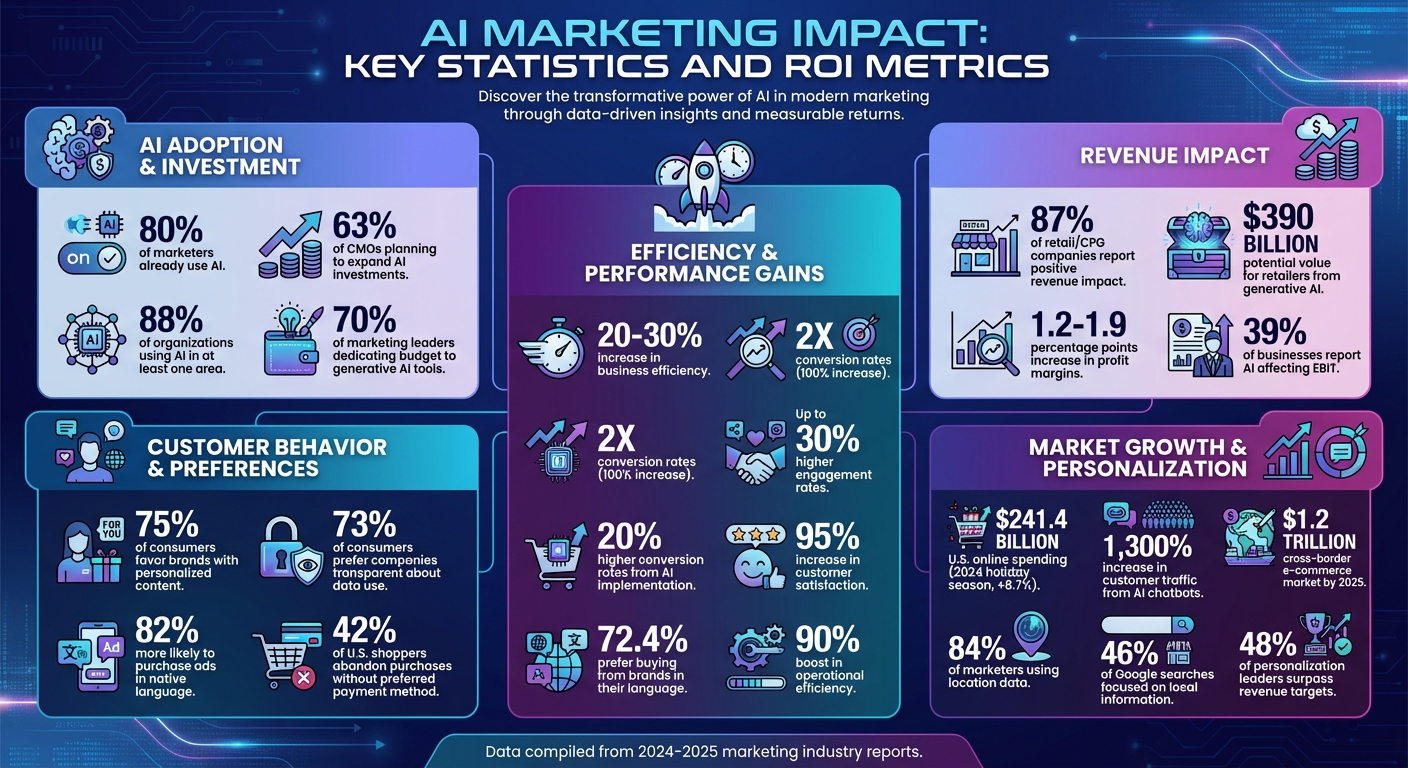
AI Marketing Impact: Key Statistics and ROI Metrics for 2024-2025
7 AI Marketing Trends That Will Transform Your Business in 2025 | HubSpot Report
How AI Changes Marketing Strategies
AI is reshaping how marketers plan, execute, and measure their efforts. Instead of relying on intuition or outdated methods, machine learning now enables marketers to predict customer behavior, refine the customer journey, and craft more effective strategies. This shift touches every aspect of marketing, from generating leads and managing customer relationships to creating content and optimizing campaigns [5][6].
AI-powered tools provide real-time insights into consumer behavior, making dynamic pricing, targeted ad bidding, and large-scale hyper-personalization possible. For example, during the 2024 holiday season, U.S. online spending surged by 8.7%, reaching about $241.4 billion, with AI-driven chatbots contributing to a staggering 1,300% increase in customer traffic [7].
Some businesses using AI for location-based targeting have seen conversion rates climb by up to 20%, while localized marketing strategies have boosted customer engagement by as much as 30% [12]. Among retail and consumer packaged goods companies, 87% report a positive impact on their annual revenue thanks to AI [10]. According to McKinsey, generative AI could unlock as much as $390 billion in value for retailers, potentially increasing profit margins by 1.2 to 1.9 percentage points [10]. This evolution highlights how AI is transforming every step of the marketing funnel.
How AI Transforms the Marketing Funnel
AI is fundamentally changing the traditional marketing funnel, making each stage faster, smarter, and more personalized.
At the awareness and interest stage, AI enables hyper-personalized targeting by analyzing massive datasets from website activity, social media, and customer feedback [7]. With nearly half (46%) of all Google searches focused on local information [8], AI helps businesses optimize for voice search and local SEO, tailoring content to match conversational, question-based queries [7][8].
During the consideration and evaluation phase, AI tools like chatbots deliver personalized content and recommendations in real time. These chatbots can handle complex conversations and maintain culturally relevant communication across multiple platforms [7][8]. This is particularly important, as 72.4% of consumers prefer to buy from brands that communicate in their language, and 82% are more likely to purchase when ads are presented in their native language [9][11].
At the decision and conversion stage, AI simplifies the buying process by offering localized payment options, currencies, and personalized offers. This is crucial in the U.S., where 42% of shoppers either switch retailers or abandon purchases when their preferred payment method isn’t available [9]. AI also provides tailored support during checkout, addressing customer concerns before they lead to abandoned carts.
For retention and loyalty, AI uses predictive analytics to anticipate customer needs, personalize post-purchase interactions, and analyze feedback for continuous improvement [7]. Businesses leveraging AI for customer retention report a 95% increase in customer satisfaction and a 90% boost in efficiency [10]. AI ensures consistent communication across all touchpoints – whether it’s through a website, social media, mobile apps, or in-store experiences [10].
New Job Roles and Skills for AI Marketing
The integration of AI into marketing is creating demand for professionals who can bridge the gap between AI capabilities and marketing strategies. Marketers now need to understand how to incorporate AI into workflows and turn AI-generated insights into actionable plans [15][16][17]. This requires training in AI tools, familiarity with machine learning concepts, and collaboration with data teams [15][17].
Key skills include mastering predictive analytics, optimizing for voice search using conversational phrases, and localizing content with AI-powered translation tools [7][9][13][14]. Many companies are hiring experts in AI and machine learning or partnering with specialized vendors to fill these roles [16]. As AI takes over repetitive tasks, marketers are shifting their focus to strategic oversight, creative direction, and customer engagement.
How AI Improves Budget Planning and Performance Tracking
AI is revolutionizing how businesses in the U.S. plan budgets and track performance, especially within the constraints of quarterly reporting and ROI metrics. By analyzing historical spending, seasonal trends, and live campaign data, AI recommends dynamic budget allocations that maximize returns.
Predictive analytics powered by AI help marketers anticipate customer behavior and seasonal patterns by analyzing purchase histories, social media trends, and regional economic indicators [7]. This allows teams to redirect resources toward high-performing channels before competitors catch up.
AI tools also monitor performance metrics across multiple platforms, identifying which campaigns drive revenue and calculating customer acquisition costs in real time. With 84% of marketers already using location data and 94% planning to adopt it, AI’s ability to optimize spending by region is becoming a standard practice [12].
In the growing cross-border e-commerce market – expected to surpass $1.2 trillion by 2025 – AI plays a critical role in tracking performance across currencies, payment methods, and regional preferences, converting all data back to USD for consistent reporting [9]. This level of analysis helps CFOs and CMOs make informed decisions during quarterly planning, backed by AI-generated forecasts that consider a wide range of variables beyond human capacity.
AI Technologies That Are Changing Marketing
AI is transforming how marketing strategies are developed and executed. Three standout technologies – customer segmentation with predictive analytics, personalization with recommendation engines, and generative AI for content creation – are reshaping the marketing landscape in the U.S. by automating processes and analyzing massive amounts of customer data at scale[18].
AI-powered customer segmentation digs deep into demographic, psychographic, and behavioral data, uncovering insights that traditional analysis often misses. This approach allows marketers to deliver highly targeted messages while making the most of their budgets[19][20]. Predictive analytics takes this a step further by using machine learning to analyze historical data, helping businesses predict key factors like purchase likelihood and churn risk[19][20].
Personalization and recommendation engines bring a tailored experience to customers by analyzing their browsing habits and purchase histories in real time. These tools deliver product suggestions and messaging that feel personal and relevant, adapting dynamically to customer preferences and even their stage in the buying process[2].
Generative AI tools, like ChatGPT, are revolutionizing content creation. These platforms can produce text, images, and even videos at scale[2][3]. They assist with everything from optimizing content and identifying keywords to structuring articles[5]. Additionally, AI-powered chatbots equipped with natural language processing can handle complex customer inquiries, adjusting their tone to match the situation[2]. For marketers juggling multiple campaigns across regions, generative AI significantly cuts production time, making it easier to manage large-scale operations.
These technologies are redefining what’s possible in marketing, streamlining workflows, and opening up new possibilities for connecting with customers.
sbb-itb-7878072
How to Implement AI in Your Marketing
Bringing AI into your marketing strategy starts with a strong foundation. Focus on organizing your data, choosing tools that can grow with your needs, and staying compliant with regulations. For instance, a notable 73% of consumers favor companies that are upfront about how they use data [21]. These initial steps are crucial to integrating AI smoothly into your existing marketing operations.
Preparing Your Data for AI
The success of AI depends heavily on the quality of your data. Start by defining your goals – whether it’s boosting lead generation, improving ad targeting, or something else. Then, audit all your data sources, such as CRM systems, analytics platforms, and customer interactions. Use automated tools to clean up outdated records, remove duplicates, and fix inconsistencies. To protect sensitive information, encrypt data both in transit and at rest, and anonymize personal details while keeping the insights intact. Regular testing and updates are a must [15][22]. With clean and accurate data, you’ll be in a strong position to integrate AI tools effectively into your systems.
Adding AI Tools to Your Current Marketing Systems
Start by introducing AI tools that can scale with your business, like those for email personalization or ad targeting. Test these tools through pilot projects before committing to a full rollout [15]. Make sure the AI platforms you choose are compatible with your existing systems, such as CRM software, website analytics, and sales tools [15]. Establish reliable data pipelines and consider cloud-based infrastructure to enable real-time data processing. Keep feeding your AI systems fresh data to maintain and improve their accuracy [16]. It’s also essential to define processes for human oversight, especially since 51% of organizations using AI have encountered at least one negative outcome, with nearly a third reporting issues related to AI inaccuracies [23].
Data Privacy and Compliance for AI Marketing
As AI transforms marketing, protecting data and adhering to privacy regulations must remain top priorities. In the U.S., marketers face a complex landscape of state privacy laws. To stay compliant, adopt a privacy-by-design approach: collect only what’s necessary, secure explicit consent, encrypt data, and document every interaction with it. Conduct regular audits to identify weaknesses and evaluate AI model outputs for potential bias by using diverse datasets. Assign a dedicated individual or team to oversee ethical AI practices and keep up with regulatory changes [15][24][25].
What’s Next for AI in Marketing
Marketing is transitioning into a model where human creativity and strategy are amplified by AI technology. In this setup, AI takes care of data-heavy tasks while people focus on directing and refining strategies [4]. This shift isn’t just about automating processes – it’s about driving growth and building real value for businesses. Currently, 88% of organizations are using AI in at least one area, and 62% are testing AI agents capable of operating independently [23]. The real challenge lies in how quickly your team can adapt to leverage these tools effectively.
Let’s take a closer look at how AI is reshaping personalization and content creation.
Real-Time Personalization and Faster Content Production
AI is making personalized marketing the new norm. With 75% of consumers favoring brands that provide tailored content and 48% of personalization leaders surpassing revenue targets, it’s clear this approach works [26]. Generative AI is also transforming how quickly content gets produced. In fact, 70% of marketing leaders are dedicating budget to these tools, and 56% are actively investing in them [26]. By 2025, it’s expected that 25% of enterprises using generative AI will deploy AI agents to streamline workflows and accelerate decisions [27]. This means marketers will be able to pivot strategies in real-time, responding instantly to customer needs and feedback.
How Companies Will Reorganize for AI
Marketing teams are evolving into centers of innovation, influencing not just campaigns but broader business strategies [27]. To thrive, companies need to blend technical know-how with creative skills, combining data-driven insights with imaginative thinking. The impact is already evident – 39% of businesses report that AI is affecting their EBIT, showing its direct influence on profitability [23]. To fully reap these benefits, organizations must establish clear accountability and ensure AI aligns with their brand values. Strong policies and measurable outcomes will be key [1].
This organizational evolution highlights the importance of continuous learning and skill development.
Keeping Your Skills Current with AI Training
"Your job will not be taken by AI. It will be taken by a person who knows how to use AI." – Christina Inge, Instructor at the Harvard Division of Continuing Education’s Professional & Executive Development [1]
The pace of change in marketing is accelerating. Skills now have a half-life of less than five years, and in some tech fields, it’s as short as two and a half [28]. To stay competitive, marketers must become proficient in predictive analytics, generative AI, and marketing automation. Start by experimenting with AI tools to understand their strengths and limitations, then seek training programs that combine technical expertise with strategic thinking. While many companies fall short in offering robust AI training [1][22], 64% of respondents say AI is driving innovation within their organizations [23]. Creating a culture of experimentation and adaptability will be essential for building marketing teams that are ready for the future.
Conclusion
AI is transforming the marketing world in ways we couldn’t have imagined just a few years ago. From using predictive analytics and customer segmentation to leveraging tools like ChatGPT for content creation, AI is enabling marketers to work more efficiently, deliver personalized experiences at scale, and achieve measurable outcomes. But it’s not just about automating tasks – it’s about rethinking how marketing is done entirely. By letting AI handle complex data challenges, marketers can focus on what they do best: strategy and creativity [4].
However, there’s often a gap between understanding AI’s potential and actually putting it to use. The solution? Dive in. Start experimenting with AI tools, learn their strengths and limitations, and build your expertise through hands-on practice.
Closing this gap often requires expert insight and a strategic shift. Resources like Artificial Intelligence Keynote Speaker provide practical education, strategic frameworks, and the inspiration needed to reshape marketing strategies. These experts help companies redesign workflows, ensure ethical AI practices, and align AI initiatives with broader business goals. Leadership also plays a crucial role – organizations excelling in AI are three times more likely to have leaders who strongly support AI adoption [23][27].
As the marketing landscape evolves at breakneck speed, those who embrace AI, extract actionable insights, and continuously refine their strategies will stay ahead of the competition [29]. Whether you’re just starting out or scaling up your AI efforts, now is the moment to act. Invest in training, experiment with tools, and seek expert guidance to fully unlock AI’s potential. The competitive edge lies in taking action today.
FAQs
How can small businesses start using AI in their marketing strategies?
Small businesses can start integrating AI into their marketing strategies by using straightforward, budget-friendly tools designed to boost efficiency and improve customer interactions. For example, AI-driven chatbots can take care of repetitive customer service tasks, while tools for personalized email campaigns and automated social media scheduling can make daily marketing tasks easier to manage.
A smart way to begin is by using AI to analyze customer data and spot trends. This insight can help you craft more focused and effective campaigns. As you get comfortable with these tools, you can gradually explore more advanced AI solutions. Taking it one step at a time allows small businesses to use AI effectively, staying competitive and improving marketing results without straining their resources.
What skills do marketers need to succeed with AI?
To thrive in today’s AI-driven marketing world, professionals need to sharpen their AI literacy – grasping how AI functions and how it can be applied effectively in marketing. Equally important are strong data analysis skills, which help in decoding customer behavior and spotting trends. Pairing these with strategic thinking ensures that AI initiatives align seamlessly with broader business objectives. And let’s not forget the importance of addressing ethical considerations to ensure AI is used responsibly and transparently.
Marketers should also get comfortable with AI-powered tools and automation platforms. These tools can transform tasks like customer segmentation, crafting personalized campaigns, and streamlining workflows. By honing these abilities, marketers can leverage AI to design smarter, more efficient strategies that keep pace with the ever-changing marketing landscape.
How does AI help businesses retain customers and improve satisfaction?
AI helps businesses keep customers happy and loyal by creating personalized and timely interactions. For instance, predictive analytics can spot customers who might be thinking about leaving. With this insight, companies can step in early, offering tailored deals or support to keep them on board.
AI also makes customer engagement more effective by delivering customized recommendations, dynamic messaging, and automated support across multiple platforms. These efforts strengthen customer connections, increase loyalty, and improve overall lifetime value. Plus, by automating repetitive tasks and scheduling interactions at the best times, companies can deliver a smooth, hassle-free experience that keeps customers coming back – all while cutting down on operational costs.