If you’re trying to pick the right Claude AI model for your needs, here’s a quick breakdown:
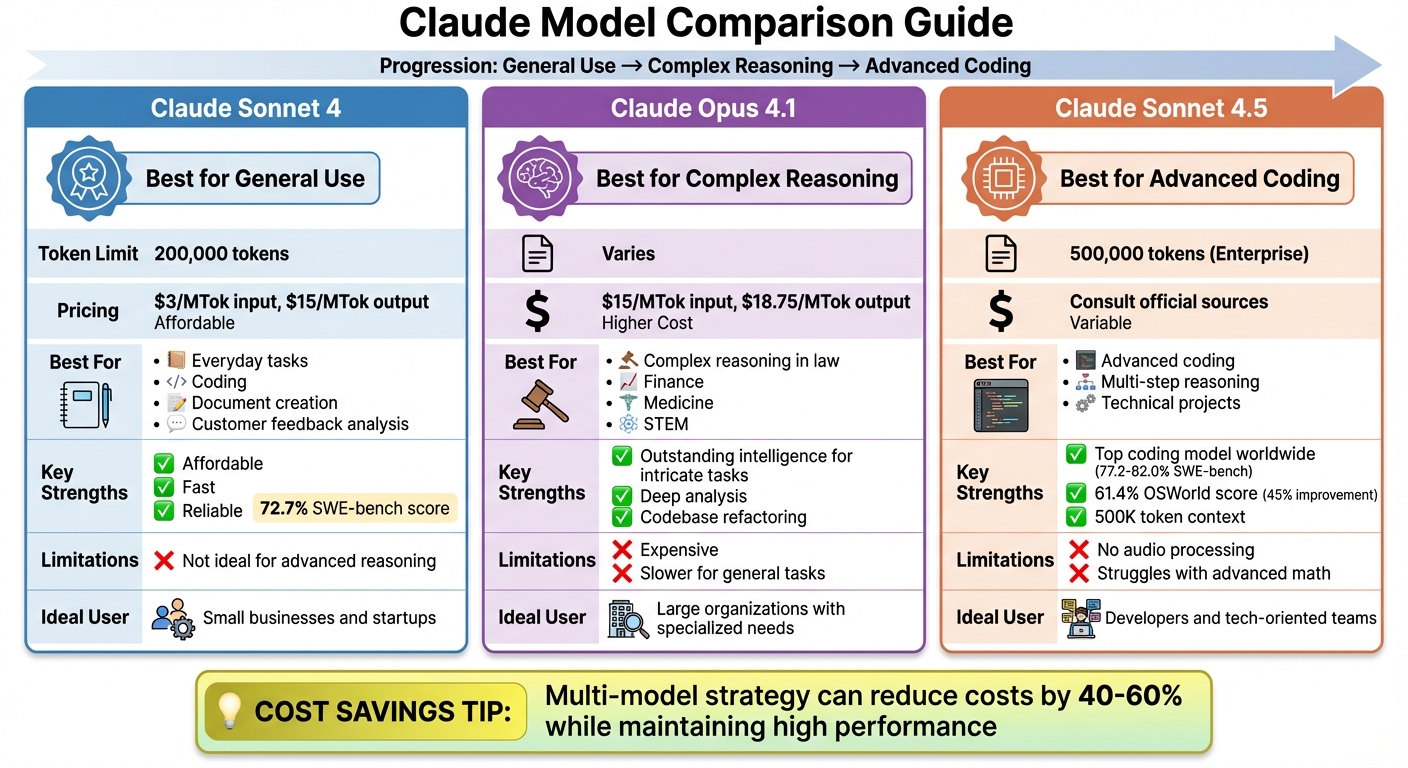
- Claude Sonnet 4: Best for everyday tasks like coding, document creation, and customer feedback analysis. Affordable at $3 per million input tokens and $15 per million output tokens. Handles up to 200,000 tokens, making it a reliable choice for general use.
- Claude Opus 4.1: Designed for complex reasoning tasks in fields like law, finance, and STEM. It’s slower and more expensive ($15 per million input tokens, $18.75 per million output tokens) but excels in deep analysis and intricate workflows.
- Claude Sonnet 4.5: The most advanced option for coding and multi-step reasoning tasks. Offers a 500,000-token context window for Enterprise users and improved performance on benchmarks. Pricing details vary, but it’s a strong performer for technical projects.
Quick Comparison
| Model | Best For | Token Limit | Pricing | Strengths | Weaknesses |
|---|---|---|---|---|---|
| Claude Sonnet 4 | General use, coding, and documents | 200,000 tokens | $3/MTok input, $15/MTok output | Affordable, fast, reliable | Not ideal for advanced reasoning |
| Claude Opus 4.1 | Complex reasoning and analysis | Varies | $15/MTok input, $18.75/MTok output | Excels in deep, detailed tasks | Expensive, slower for general tasks |
| Claude Sonnet 4.5 | Advanced coding and workflows | 500,000 tokens (Enterprise) | Consult official sources | Top coding performance, versatile | Limited in audio and math tasks |
For small businesses, Sonnet 4 is a great pick for affordability and versatility. Larger organizations might prefer Opus 4.1 for high-level reasoning or Sonnet 4.5 for technical projects. Combining models for specific tasks can save costs and improve efficiency.
Claude AI Model Comparison: Features, Pricing, and Use Cases
1. Claude Sonnet 4
Claude Sonnet 4 combines quick response times with advanced analytical capabilities, making it versatile for both straightforward tasks and more intricate challenges. As a hybrid model, it features an optional extended thinking mode for tackling complex problems [6]. It also improves reliability in agent configurations compared to its predecessors [6]. Below, we explore its performance, practical applications, pricing, and integration options.
Performance
Claude Sonnet 4 sets a high standard in the SWE-bench Verified software engineering benchmark, achieving a leading score of 72.7% [7]. Its 200,000-token context window ensures coherent long-form outputs and consistent character behavior, even in extended interactions [5][2]. In safety and alignment testing, it scored an impressive 98.7% and became the first model to completely avoid blackmail scenarios. Additionally, compliance with harmful requests dropped to below 5%, a significant improvement over the 20–40% seen in earlier versions [2].
Use Cases
This model shines in agent-based scenarios. It powers GitHub Copilot‘s upgraded coding agent, dramatically reducing multi-feature app development errors from 20% to nearly zero, and offers precise code editing capabilities [7]. Beyond coding, Claude Sonnet 4 can generate various file types like spreadsheets, slide decks, and text documents. It also supports executing code in a secure, sandboxed environment during conversations [4].
Pricing
Claude Sonnet 4 is priced at $3 per million input tokens and $15 per million output tokens [7]. It is available through Pro plans ($20/month), as well as Max, Team, and Enterprise options [7]. Users benefit from noticeable advancements in code quality and problem-solving efficiency [7].
Deployment Options
Integration is seamless through the Claude API, AWS Bedrock, or Google Cloud‘s Vertex AI [7]. The model also supports image input and vision capabilities, expanding its versatility [4].
2. Claude Opus 4.1
Claude Opus 4.1, while not the newest model, still holds a niche appeal for specific business applications [4][6]. It’s tailored for organizations that prioritize advanced reasoning for intricate tasks, setting it apart from the more broadly focused Sonnet models.
Performance
Opus 4.1 shines in handling prolonged, complex tasks and creative writing projects. However, its specialized reasoning in fields like finance, law, medicine, and STEM doesn’t quite match the capabilities of Claude 4.5 [4][7].
Use Cases
This model is best suited for scenarios that demand top-tier reasoning power. While it excels in such tasks, many simpler or faster models may be more practical for less demanding applications [9].
Pricing
For businesses, it’s crucial to assess actual workloads and consult official pricing details [1]. Opus 4.1 should be reserved for tasks where its advanced reasoning abilities are essential. To manage costs effectively, keep an eye on usage and consider shifting simpler tasks to more efficient models when possible [8][9]. This balance of pricing and capabilities sets Opus 4.1 apart from the Claude Sonnet series, which will be discussed next.
3. Claude Sonnet 4.5
Claude Sonnet 4.5, developed by Anthropic, is their go-to model for most applications. It strikes a great balance between intelligence, speed, and cost, making it a solid choice for a wide range of tasks[5].
Performance
This model is celebrated as the top coding model worldwide, earning accolades for its performance on various coding benchmarks[2][8]. But it’s not just about coding – Sonnet 4.5 shines in handling complex, multi-step reasoning tasks. This makes it particularly valuable for business workflows that demand sustained focus and precision[10].
One standout metric is its OSWorld benchmark score: 61.4%. This marks a 45% improvement over its previous version, showcasing its ability to handle desktop and web task automation with higher efficiency and accuracy[1][8]. These advancements aren’t just numbers – they translate into real-world advantages, especially in demanding workflows.
Use Cases
Sonnet 4.5 is ideal for tasks requiring advanced agentic behavior and seamless computer navigation. Businesses can leverage it to automate software navigation, execute multi-step workflows, and tackle coding projects with ease[1][10]. Its ability to maintain context over multiple steps also makes it a strong candidate for data analysis tasks, where keeping track of intricate details is essential.
Pricing
For pricing details, it’s best to consult official sources. Sonnet 4.5 is recognized for offering a well-rounded combination of performance, speed, and affordability to meet diverse needs.
sbb-itb-7878072
Strengths and Weaknesses
Each Claude model offers unique advantages and trade-offs, allowing businesses to choose the model that best aligns with their needs.
| Model | Key Strengths | Limitations |
|---|---|---|
| Claude Sonnet 4 | Affordable pricing at $3/MTok input and $3.75/MTok output; strong context-handling abilities; a reliable mix of speed and intelligence for daily tasks[11][12] | Falls short on complex reasoning and advanced autonomous coding compared to newer models; underperforms on specialized benchmarks relative to Sonnet 4.5 |
| Claude Opus 4.1 | Outstanding intelligence for intricate tasks; excels in nuanced collaborative efforts; well-suited for tasks like codebase refactoring and deep analysis[9] | Higher pricing at $15/MTok input and $18.75/MTok output; may be excessive for simpler tasks; slower than the Sonnet models[11] |
| Claude Sonnet 4.5 | Strong performer in autonomous coding, scoring 77.2%–82.0% on SWE-bench benchmarks[11]; adept at multi-step reasoning and tool orchestration; offers a 500,000-token context window for Enterprise users[11][14] | Lacks integrated audio processing[16]; struggles with advanced mathematical tasks[16]; requires external tools for voice-based applications |
While the table highlights the key characteristics of each model, diving deeper reveals how these strengths and limitations play out in real-world scenarios.
One standout feature across the Claude lineup is the Constitutional AI framework, which actively reduces harmful outputs. This makes the models particularly appealing for industries like healthcare and finance, where minimizing legal risks is critical[11][13][16]. Additionally, the models’ ability to handle up to 200,000 tokens (and 500,000 for Enterprise users) ensures seamless handling of lengthy documents and complex workflows[11][12][16].
For organizations prioritizing data security, Claude offers robust protections by ensuring enterprise data is not stored between sessions[3][15]. This feature is especially valuable for businesses dealing with sensitive or confidential information, where compliance and privacy are non-negotiable.
Conclusion
For small businesses and startups, Claude Sonnet 4 is a reliable choice for managing everyday tasks like drafting messages and analyzing customer feedback. On the other hand, larger organizations often require more advanced capabilities. For those handling specialized or complex projects, Claude Opus 4.1 offers enhanced reasoning and deeper analytical power. Meanwhile, developers and tech-oriented teams gravitate toward Claude Sonnet 4.5, which excels at handling intricate workflows and advanced coding tasks.
Choosing the right model depends on the complexity of your tasks and the scale of your operations. Many businesses find success with a multi-model strategy, which leverages different Claude models for specific needs. This approach can cut costs by 40–60% while maintaining high performance[12][3]. For example, straightforward queries can be directed to Sonnet 4, critical analyses can utilize Opus 4.1, and advanced development tasks can be handled by Sonnet 4.5. By tailoring model usage to specific tasks, organizations can achieve greater efficiency and cost savings while getting the most value from their AI solutions.
FAQs
What should I consider when deciding between Claude Sonnet 4 and Claude Sonnet 4.5?
When choosing between Claude Sonnet 4 and Claude Sonnet 4.5, it’s important to weigh the updates and improvements that come with the newer version. Claude Sonnet 4.5 builds upon its predecessor by offering better performance, updated features, and smoother functionality.
Think about your specific needs: What kind of tasks will you be tackling? How complex are they? If your goals align with the advanced capabilities or increased efficiency of Claude Sonnet 4.5, it might be the right fit for you.
What’s the best way to manage costs when using different Claude models for various tasks?
To keep costs under control, select the Claude model that aligns with the specific needs of your task. For straightforward or smaller tasks, Haiku is a great option to conserve resources. For more in-depth work, such as professional analysis or creating longer documents, Sonnet is a better fit. When tackling tasks that require complex reasoning or advanced problem-solving, Opus is the ideal choice.
Choosing the right model for the job helps you avoid unnecessary spending. You can also use API billing tools to monitor and manage your expenses, ensuring you stay on budget while maintaining productivity.
Is the higher cost of Claude Opus 4.1 justified for handling complex reasoning tasks?
Claude Opus 4.1 shines when it comes to handling complex, long-term tasks. It’s designed to pull together insights from various data sources, navigate uncertainty, and weigh different options with little need for direction. While it may come with a higher price tag, its advanced features can offer immense value to businesses facing intricate problems.
For companies that need strong analytical and problem-solving tools, investing in Claude Opus 4.1 could make a lot of sense – especially if their challenges demand this level of sophistication.